
 Cart is empty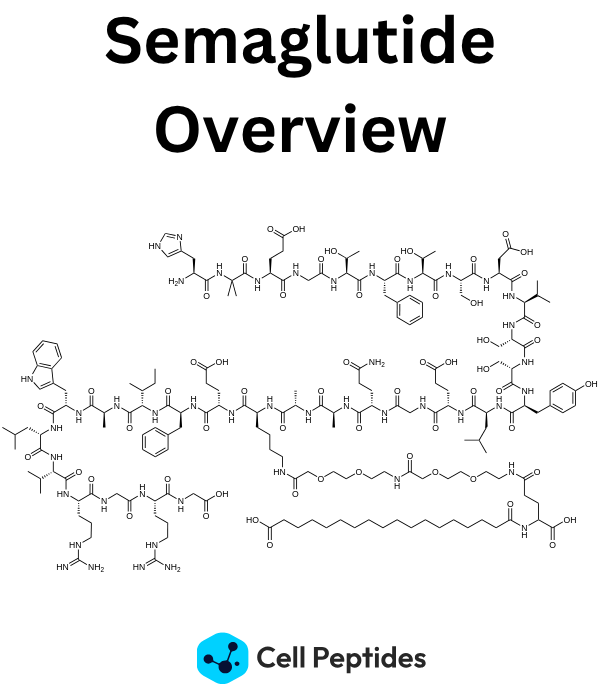
*The below article and information are based on lab research data of Semaglutide, this is not medical advice in any kind of shape or form.
What if a weekly peptide injection could stop food cravings, keep blood sugar levels in check, and slow the rate at which the stomach processes food — keeping people feeling full for longer? And what if that same peptide also happened to have surprising benefits for the brain and the heart?
It would have sounded like sci-fi not too long ago, but you know it isn’t. The buzz around Semaglutide hasn’t been confined to the pages of medical journals, after all. It’s also dominated headlines around the world.
This GLP-1 peptide was created to treat type 2 diabetes, but newer research has demonstrated that it does much more than that. Trials have confirmed powerful cardiovascular benefits — a 20 percent lower risk of stroke and heart attack — but also kidney protection. Neurological effects like inflammation-fighting and better insulin sensitivity in the brain could benefit people with Alzheimer’s and beyond. Those are the next research targets, and who knows what comes next?
Semaglutide is already actively changing lives as an approved obesity treatment. Future research will almost certainly lead to applications that help millions more.
A Brief History of Semaglutide & How It Got Discovered
It’s a longer history than you might think if you’ve only recently started paying attention to this peptide.
Glucagon-Like Peptide-1, on which Semaglutide is based, was identified back in the 1980s. This natural human hormone gets released in the gut after eating. GLP-1 makes the pancreas release insulin when it’s needed and keeps glucagon under control. It also stops people from eating too much by making them feel full for longer. [1]
The huge potential didn’t escape their attention. There was a colossal problem, though. The body destroys GLP-1 within two minutes — useless as a treatment.
Gila monster venom bridged that gap. That sounds weird, but stick with it. The Gila monster (that’s an obscure lizard, by the way) makes a compound that scientists later called Exendin-4. That compound works a lot like human GLP-1, scientists noticed, except it doesn’t degrade nearly as quickly. That compound became Exenatide. The very first GLP-1 receptor agonist. Exenatide was exciting and more practical than GLP-1 as a treatment, but it still required twice-daily injections to have an effect. Not good enough.
The science team at Novo Nordisk that created Semaglutide experimented with changing the structure of human GLP-1, instead. They eventually succeeded. Semaglutide is a synthetic GLP-1 peptide that sticks around — for a week.
Semaglutide survived all the stress tests and human trials researchers threw at it. After being approved as a type 2 diabetes treatment, the dramatic weight loss benefits could no longer be ignored. Other weight loss drugs were thought of as effective if they could shave off five to 10 percent. Semaglutide could do better than that with 15 percent, not as an aspirational maximum but an average outcome. [2]
How Does Semaglutide Actually Work?
In three different ways, because GLP-1 receptors are found all over the body:
- Semaglutide works the appetite centers in the brain, so people who’ve had enough to eat are no longer tempted by out-of-control cravings that make them want more anyway. This is the biggest reason behind the drastic weight loss that’s made Semaglutide so interesting.
- It also bosses the pancreas around — release insulin and keep glucagon down when blood sugar levels are high, but hold fire when everything’s OK. That part is why Semaglutide has become a next-gen diabetes treatment. Other treatments come with a risk of excessively low blood sugar, but this peptide avoids that problem.
- Semaglutide keeps food in the stomach for longer — so right as it tells the brain to feel satisfied, it also triggers a physical feeling of fullness. When eating just one more bite becomes uncomfortable, you lay off.
Those main effects make it abundantly clear why Semaglutide has taken the fields of type 2 diabetes and obesity treatment by storm. Given its observed effects on heart and kidney health, Semaglutide clearly does more, though. It takes a look at the most important studies published so far to understand what that might be, so let’s go there next.
Semaglutide for Weight Loss, Type 2 Diabetes, and Far Beyond: What the Research So Far Says
Semaglutide has already well and truly been established in the clinical canon as an effective treatment for obesity and type 2 diabetes.
The STEP 1 trial changed obesity management options forever — bariatric surgery used to be the only reliable way to get the results Semaglutide demonstrated, but participants lost on average 15 percent of their starting body weight. And they didn’t need to have diabetes to benefit from those extremely successful outcomes. [3, 4]
Type 2 diabetes results were just as impressive. The SUSTAIN-6 trial saw HbA1c reductions comparable to those seen in insulin users or people without diabetes. The important difference? Insulin comes with the risk of hypoglycemia, but Semaglutide doesn’t drop blood sugar levels to dangerously low levels. [5]
Those findings have made headlines everywhere, and most people (even folks who aren’t obese, diabetic, or in a scientific field) are already all too familiar with them by this point. The lesser known research developments in other fields are just as interesting, though — and definitely worth reading about if you think of Semaglutide only as a weight loss and diabetes drug.
Semaglutide Protects Heart Health
Trial after trial has shown protective effects on heart health — at first in type 2 diabetes patients, and then also in people with cardiovascular disease but not diabetes. The effects proved to be more than merely “statistically significant,” as well. A 20 percent reduction in the risk of heart attack and stroke, but also death from cardiovascular causes? “Not too shabby” would be the understatement of the century. [6, 7]
Semaglutide as a Safe and Effective Treatment for MASH
Insulin resistance is a key cause of metabolic dysfunction-associated steatohepatitis — which some people are more likely to recognize by its old name, non-alcoholic fatty liver disease or steatohepatitis. Semaglutide zooms in on the exact mechanism that improves it, and clinical trials have made exciting inroads. The peptide slashes liver fat content and liver enzyme levels so much that studies have already described it as “safe and efficacious for NASH resolution.” [8]
How Semaglutide Can Reduce Neuroinflammation and Brain Insulin Sensitivity
Speculative, but actively researched — and supremely exciting. GLP-1 is already known to have anti-inflammatory and neuroprotective effects, and the brain is home to receptors. Alzheimer’s patients have chronic brain inflammation, and their glucose metabolism goes haywire. It’s colloquially called “type 3 diabetes” for exactly that reason.
Could a peptide that started off as a type 2 diabetes treatment and then took the field of obesity research by storm also slow the progress of Alzheimer’s, and perhaps even other neurodegenerative diseases? The EVOKE trial continues to look at this. More headlines? Almost certainly incoming. [9]
Semaglutide Stops Food Cravings — and Research Is Already Targeting Other Addictions
The 15 percent weight loss people with Semaglutide prescriptions are able to achieve is attributable to several different mechanisms. An end to food cravings is one of the most important ones, and that process takes place in the reward centers of the brain. The idea that this same process could also help people with other substance and behavioral addictions makes sense, and studies into this possibility are currently in full swing. [10]
Semaglutide to Improve Insulin Resistance, Fertility, and Weight in PCOS Patients
This one almost feels like an afterthought, but only because PCOS is so very closely linked to insulin resistance and it’s only logical that Semaglutide would be promising in this area. The six to 13 percent of women who suffer from Polycystic Ovary Syndrome across the world would beg to differ, of course. Semaglutide improves insulin resistance and helps obese people lose serious weight. It’s not at all unexpected that this translates to more predictable menstrual cycles and better fertility for PCOS patients. [11]
How Is Semaglutide Administered in Research Settings?
Semaglutide shares 94 percent of its structure with the natural, native GLP-1 the human body makes — with tweaks made to extend its half-life to a week. That’s made administration convenient. Research uses two main delivery routes — subcutaneous injection and oral.
A once-weekly subQ or IM injection is the more common choice, because it’s got excellent bioavailability and reaches the bloodstream effectively. Clinical use for obesity follows this same pattern, and patients don’t find it too difficult to learn how to self-administer these injections.
However, oral delivery is also used in some research — especially when studying type 2 diabetes. Tablets have an absorption booster that makes them more bioavailable.
How Do Researchers Determine Dosing Protocols for Semaglutide? And What Are Its Current Dosages That Have Been Researched?
Extensive Phase III clinical trials have led to an established dosing protocol, and new study designs follow or adapt it:
- Weight management applications use incrementally increasing doses — first 0.25 mg a week for four weeks, then 0.5 mg, 1.0 mg, and 1.7 mg. The final maintenance dose is often 2.4 mg a week.
- Type 2 diabetes studies use slightly lower doses. Much of the literature cites caps of 1.0 mg or 2.0 mg a week.
- Heart health research often starts with 0.25 mg and slowly bumps up to a max of 1 mg.
Researchers can and should take advantage of the very thorough reviews that have already taken place. Existing research gives insights into the best dosing protocol, even when the study targets a new or less-researched line of inquiry. [12]
Are There Any Contraindications?
Yes — not everyone is a good candidate for Semaglutide, and that’s reflected in trial participant selection as well as clinical use. As always, a known sensitivity to Semaglutide (established by previous administration) disqualifies subjects from further participation. People with a family or personal history of Medullary Thyroid Carcinoma can’t take Semaglutide, and neither can those with Multiple Endocrine Neoplasia syndrome type 2.
Semaglutide Is a ‘Multi-System Influencer’ — and Research Continues
Its results in type 2 diabetes treatment were already impressive enough, and the extremely effective weight loss results took Semaglutide from impressive to revolutionary. The most exciting part? It’s quite possible that the current body of science has only scratched the surface. Research directions already include heart health and brain protection. Time — and a whole lot of research — will tell what’s next for Semaglutide.
FAQs
Weight loss results are progressive — and they take time. Participants in landmark clinical trials usually saw their first weight loss results within 16 weeks. It took until the maximum dose was reached for the most dramatic losses to appear, and the final results were seen after 60 to 68 weeks. The rate of weight loss can vary. It tends to start fast, slow down, and then speed up again.
Semaglutide is impressive, but not so impressive that it keeps working indefinitely when it’s no longer used. Obesity is a chronic condition and maintenance doses might be required. Many trial participants do manage to keep a lot of the weight off.
Not directly, but any dramatic weight loss can sometimes cause hair loss or thinning — after Semaglutide, but also surgery or heavy dieting. Hair loss related to weight loss is temporary.
The most important point here is that Semaglutide slows gastric emptying. That can impact the rate and efficacy with which some oral medications get absorbed. Research designs should take this into account, as should doctors prescribing Semaglutide.
Scientific References and Sources
- https://www.jci.org/articles/view/175634[↩]
- https://pubmed.ncbi.nlm.nih.gov/23231438/[↩]
- https://www.tandfonline.com/doi/full/10.1080/00325481.2022.2147326#d1e430[↩]
- https://pmc.ncbi.nlm.nih.gov/articles/PMC9758543/[↩]
- https://academic.oup.com/ndt/article/40/2/352/7704453[↩]
- https://link.springer.com/article/10.1007/s13300-024-01659-7[↩]
- https://www.nejm.org/doi/full/10.1056/NEJMoa2307563[↩]
- https://www.nature.com/articles/s41575-020-00396-z[↩]
- https://link.springer.com/article/10.1186/s13195-024-01666-7[↩]
- https://journals.sagepub.com/doi/abs/10.1177/29767342251351111[↩]
- https://www.tandfonline.com/doi/full/10.1080/20565623.2025.2483607[↩]
- https://www.drugs.com/dosage/semaglutide.html[↩]