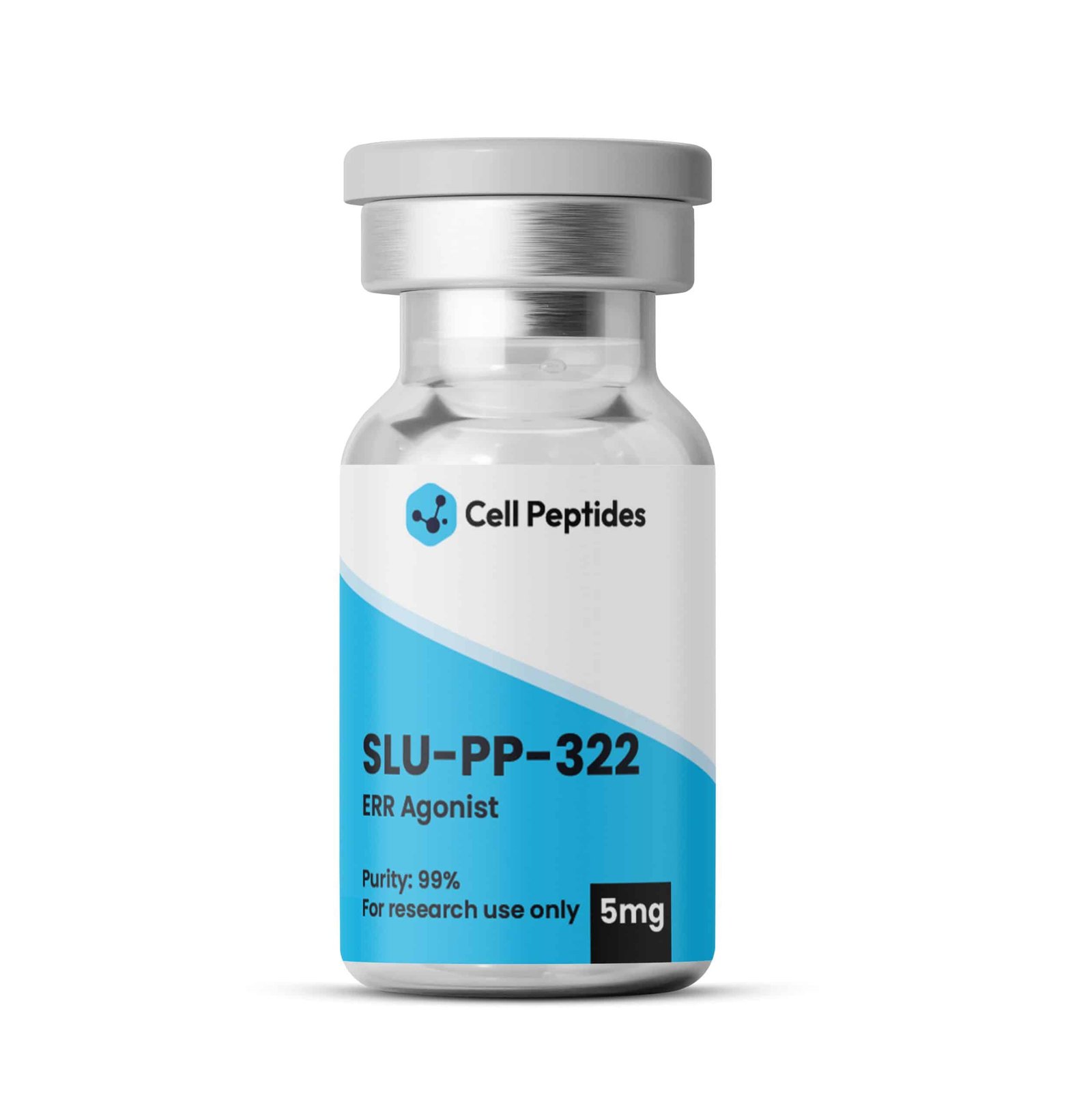
Why Choose CellPeptides for Your SLU-PP-332 Research?
The development of SLU-PP-332 (“exercise in a bottle”) was a real pharmacological breakthrough. It paved the way for research and future clinical applications that simply weren’t possible before — and it definitely wasn’t easy.
CellPeptides is an EU-based research chemical company who tries to live up to that exciting legacy. We provide pharmacological-grade SLU-PP-332 with the potential to form the basis for brand new discoveries.
With us, you get:
- ≥99% purity — as pure as it gets, and completely ready for your ambitious study design.
- Certificates of analysis from independent labs, so you can check purity and composition for yourself.
- Fast, global, insured, and safe shipping. With tracking, of course.
- Flexibility when it comes to payment. Don’t like credit cards or bank transfers? We take crypto, too.
- A knowledgeable support team that will get your questions answered — if there’s a glitch with your order, but also if you’d like to run your research design by us.
We handle the reliability (our SLU-PP-332 is synthesized in an EU-based WHO/GMP and ISO 9001:2015 certified lab), so you get the compound you need to contribute to the future of science. Every time.
What Is SLU-PP-332, and What Makes This Compound Interesting for Research?
You wanted a look under the hood, and you’ll get one. SLU-PP-332 is a small molecule synthetic compound (not a peptide) specifically designed to act on estrogen-related receptors. A team from St Louis University led the way — hence the “SLU” in the name.
Three of these receptors exist, and SLU-PP-332 targets them all. Switching them on creates a state usually induced when people are under physical stress, AKA when they’re engaged in endurance exercise. That, in turn, has some interesting knock-on effects. Cells make more mitochondria. Muscles burn fat for energy — and they’re optimized for endurance.
Basically? SLU-PP-332 makes muscles more metabolically efficient. It makes them more resistant to fatigue. It creates an environment usually only available to people who’ve been subjecting themselves to strenuous resistance training. That? It might make SLU-PP-332 sound like the “lazy way out” for people who want all the benefits of exercise with none of the effort, but it has a surprising range of research applications. SLU-PP-332 might, in the future, help people who can’t exercise due to physical limitations or who are recovering from serious physical injuries — but also type 2 diabetics and people suffering from obesity.
The Most Exciting SLU-PP-332 Research So Far — and a Glimpse of What’s to Come
SLU-PP-332 pretty much remains a newborn in the grand scheme of things; the first research paper — which studied its effects on mice — was only published in the early 2020s. You’d be forgiven for thinking that means further studies are limited, but that’s not quite true. The landmark study was so exciting that researchers have jumped at the chance to discover what else SLU-PP-332 can do.
SLU-PP-332 Supercharges Endurance (and That’s Not an Understatement)
That first study? It had astonishing results — and no, we’re not overhyping that. Mice given SLU-PP-332 could suddenly run 70 percent longer and 50 percent further. Without previously exercising. Other performance boosters tend to be stimulants, but SLU-PP-332 doesn’t rely on “cheap tricks” that lead to impressive but woefully transient results.
The initial research showed that the mice in the study underwent a total metabolic shift. They started burning fat (nearly exclusively!) while leaving carbs intact. They acquired the metabolic efficiency and physiological profile of mice subjected to grueling training regimens. Except they weren’t. They were just given SLU-PP-332.
What’s more, the mice in that first study made new mitochondria (you know it, the “powerhouse of the cells” and all that!) at much faster rates. That, in turn, makes muscles even more powerful. [1]
SLU-PP-332 and Metabolic and Muscle-Loss Research
Those findings alone are incredible. They make SLU-PP-332 an obvious compound to study in the context of metabolic syndrome, sarcopenia (age-related muscle loss), type 2 diabetes, and neuromuscular diseases (like MS and muscular dystrophy). Indeed, SLU-PP-332 studies devoted to all of these areas have already been conducted in the short time the compound has been around. [2, 3, 4, 5]
These directions of inquiry raise some interesting questions. Could the compound give people unable to exercise because they’re too old, frail, or sick a helping hand as they struggle to hold onto muscle mass? Could the switch to fat metabolism that SLU-PP-332 forces, and its mitochondrial function boost, be part of new treatments for type 2 diabetes and obesity? Research that will answer these questions continues — but those aren’t the only areas under active investigation!
New Areas of Study: SLU-PP-332 for Heart Failure, Neurological Diseases, and More
Ready? Good, because many SLU-PP-332 studies go much further than the obvious (“exercise in a bottle”) — something that shows it to be a pretty versatile compound with a massive range of potential clinical applications.
Studies have already identified SLU-PP-332 as a potential agent for patients with heart failure or at risk of it. The compound improves mitochondrial function and fatty acid metabolism, so that shouldn’t be too surprising. [6]
Ambitious researchers have raised the possibility that this same mechanism could be beneficial in treating neurological diseases — Alzheimer’s and Parkinson’s, perhaps, but also potentially schizophrenia, which is strongly associated with metabolic dysfunction. [7] This line of inquiry is still in its very earliest stages, mind you, but it’s too interesting not to mention.
Beyond that, SLU-PP-332 has been proposed as a treatment for COVID [8], and even as a potential inhibitor of cancer cell growth [9]. Does that make you go “Wow?” You’re not wrong — SLU-PP-332 is arguably one of the most interesting compounds to study right now.
Who Might Consider Researching SLU-PP-332?
Broad and vague, but true — SLU-PP-332 is the perfect research compound for anyone asking all the big questions about energy management at the cellular level. That includes, but definitely isn’t limited to, researchers who investigate:
- Exercise, endurance, and performance — specifically, how reaping the adaptive benefits of exercise without exercising can help very broad groups of people, from muscular dystrophy patients to folks recovering from surgery and older people who can’t exercise anymore due to frailty.
- New treatments for obesity and type 2 diabetes, areas where the compound is already actively investigated.
- Cardioprotective measures — the potential to make heart tissue more effective while simultaneously optimizing mitochondrial function is super exciting right now.
- For that matter, anyone researching mitochondrial proliferation needs to keep an eye on SLU-PP-332.
Dream of controlling metabolic pathways? SLU-PP-332 deserves a spot on your radar. And in your lab.
Common Dosing Protocols for SLU-PP-332 Researched In-Vitro Models
Dosing decisions depend on the model — and the goal of the study. Despite SLU-PP-332 being a fairly new compound, researchers have plenty of studies to review to aid their own designs.
You might come across doses of 5 to 15 mg per kilogram of body weight for in vivo research, administered once a day. The protocol is different for in vitro research — there, doses of 1 µM to 10 µM are common. Even oral applications have been developed for the compound, although they’re rarer.
But most begginer researches tend to use doses of 0.3-1mg per day.
Effects are dose-dependent, so determining the optimal protocol is always the first step. Once that’s done, researchers also have to keep in mind that lyophilized SLU-PP-332 needs to be reconstituted to prepare it for research. Bacteriostatic water is the only sterile solvent suitable for the multi-dose design most studies use. It allows investigators to store the compound safely in the fridge and maximize the ROI they get from a single vial.
That’s done by injecting BAC water into the vial of dry SLU-PP-332 — for example, 1 mL for a 5 mg vial. Take it slow, and angle the needle at the vial wall. Swirl or roll until the solution becomes clear. No shaking, because that can upset and denature the compound.
Use our peptide dosage calculator in order to find out the correct dose for your model.
Scientific References
- https://storage.prod.researchhub.com/uploads/papers/2023/10/28/2022.10.05.510974.full.pdf
- https://jpet.aspetjournals.org/article/S0022-3565(24)17157-1/abstract
- https://ujpronline.com/index.php/journal/article/view/1355
- https://www.frontiersin.org/journals/physiology/articles/10.3389/fphys.2025.1616693/full
- https://jmsgr.tamhsc.edu/roles-of-estrogen-related-receptors-in-skeletal-muscle-fatigue-associated-with-exercise-and-their-potential-therapeutic-effects/
- https://www.ahajournals.org/doi/abs/10.1161/circ.144.suppl_1.9682
- https://www.preprints.org/frontend/manuscript/49c95aea224f55a22796398e5dabc3e3/download_pub
- https://www.sciencedirect.com/science/article/pii/S0306987724001051
- https://pubs.acs.org/doi/abs/10.1021/acschembio.0c00670



 Cart is empty