Why Choose CellPeptides’ PEG-MGF?
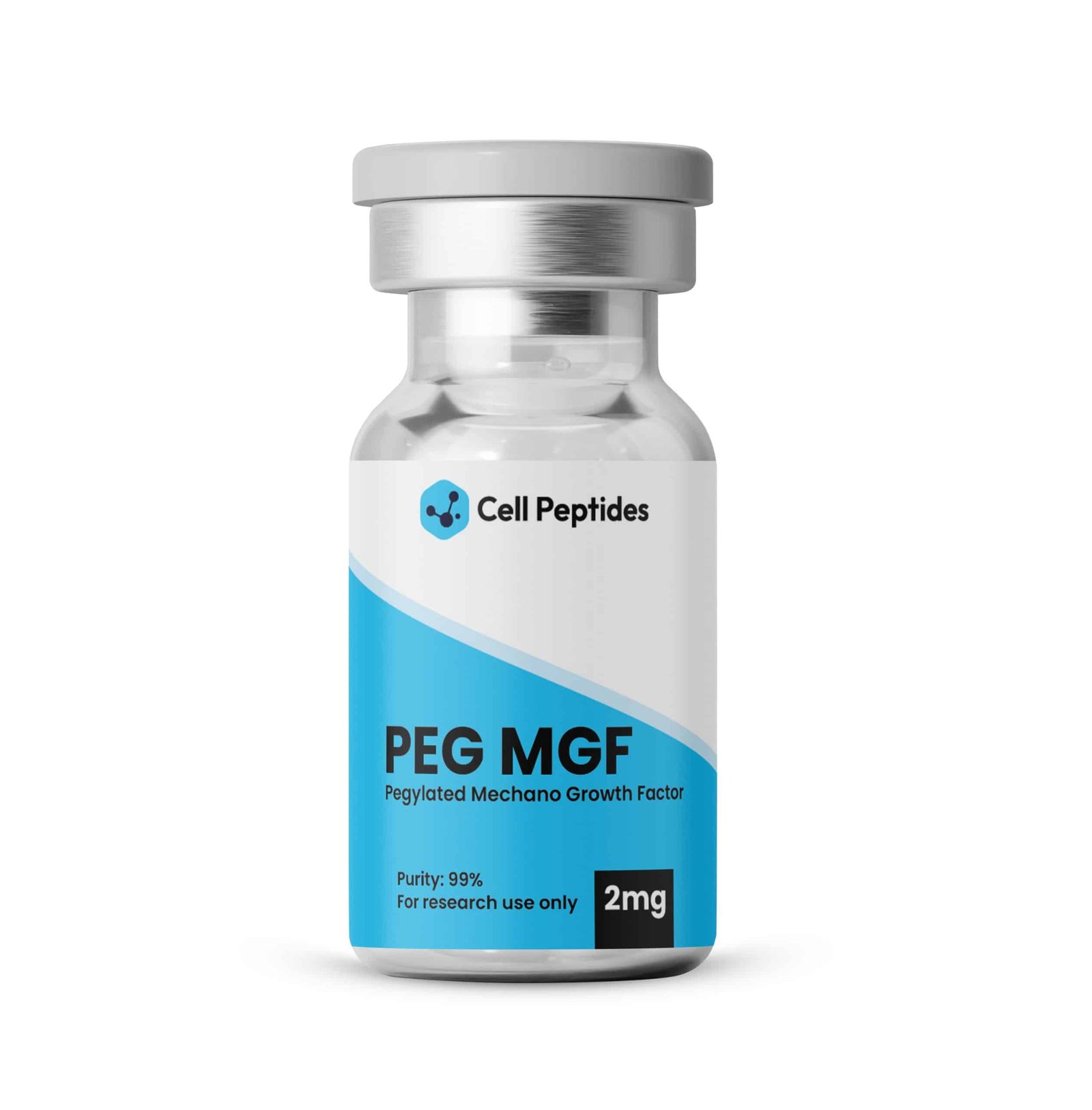
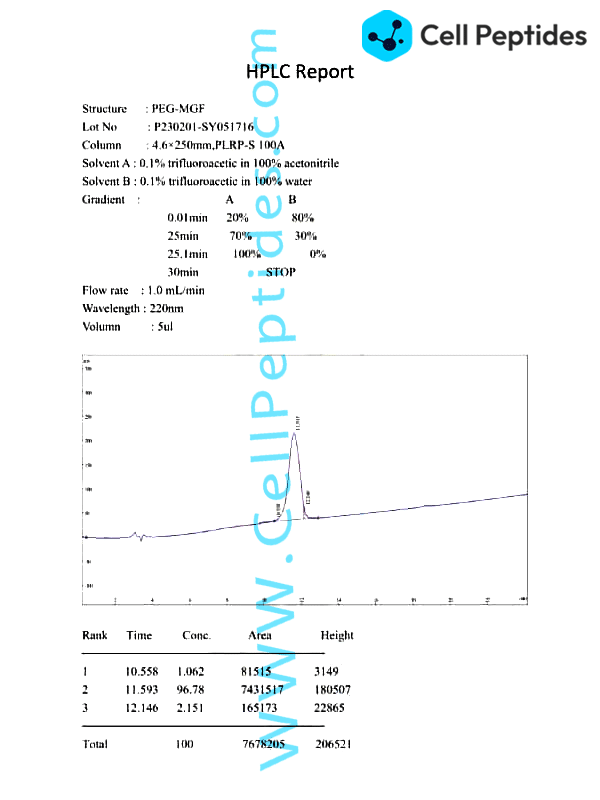
All peptides are different — and with PEG-MGF, purity, stability, and correct splicing are the quality differentiators to look for. CellPeptides is a European research and scientific company dedicated to providing lab-grade peptides for your experiments. We know the integrity of your results depends on precise sequencing. Our PEG-MGF is synthesized and verified with mass spectrometry, and we extend MGF’s half life without masking its active site.
When you source PEG-MGF from us, you get a peptide that’s:
- Pharma-grade, ≥99% purity — non-negotiable for serious research.
- Independently lab tested, so you can check purity and composition yourself.
- Shipped safely, globally, and quickly. With tracking. So you can get your study started ASAP.
We take credit cards and accept bank transfers, but researchers who prefer cryptocurrency will be pleased to know we accept that, too. And if you have questions? CellPeptides is always on hand, for research support and technical hiccups alike.
How PEG-MGF Works
PEG-MGF is one of the most interesting peptides for research into muscle recovery and growth — the synthetic, stabilized upgrade that the Mechano Growth Factor the body naturally makes when it’s most needed.
It works nearly exactly like MGF. With one important difference.
Heavy physical exertion and damage (like, for example, a workout that pushes you to your absolute limit) make IGF-1 splice differently. It produces the MGF isoform, your muscles’ very own paramedic. That creates a pool of brand-new stem cells with the job of repairing and rebuilding muscle tissue.
Just like actual paramedics, however, MGF doesn’t stick around for long. With a half life of mere minutes, it needs PEGylation to become viable for research. PEG-MGF protects Mechano Growth Factor from lightning-fast enzymatic degradation — so it can act for 24 to 48 hours, and sometimes beyond.
(Oh, and an interesting bonus? Research hints that MGF might also improve glucose uptake and slow programmed cell death in damaged tissues.)
PEG-MGF in Research: Targeted Use Cases Explored So Far
Research into the potential applications of PEG-MGF mainly focuses on in vitro and in vivo models at the moment — human trials are pending. Findings to date are nothing short of remarkable. They show that PEG-MGF is a powerful peptide that specializes in one very important job. Targeted, localized tissue repair.
The excitement is warranted, and it directly results from the way PEG-MGF works. It replicates the body’s first response to damage. That? That opens doors to inquiries into muscle, metabolic, cardiac, and neurological health — as a growing body of science is already beginning to show.
Research Into PEG-MGF for Muscle Repair and Growth
Muscle repair and hypertrophy (that is, growth) are the most-researched applications. Studies have shown that PEG-MGF speeds up muscle repair in injured animal models — but also that it slows muscle wasting and helps the body build stronger muscles. It does all that while lowering the inflammation associated with these kinds of injuries. [1, 2]
We’ve already looked at how that works; PEGylated Mechano Growth Factor floods damaged sites with stem cells, which quickly proliferate and fuse with existing tissue to build back stronger. Current research already gives hope to people with muscle-wasting conditions [3], for which treatment options have been rather limited so far, but applications in sports medicine and bodybuilding are also obvious.
Localized Recovery Support and the Potential of PEG-MGF
PEG-MGF has already gained a reputation for supporting muscle recovery in the bodybuilding community and among sports medicine researchers. That potential, however, stretches further than muscle repair alone. Rabbit models have already looked at PEG-MGF for cartilage healing — something the body is naturally bad at, usually leading to scarring followed by osteoarthritis — with impressive results. [4]
Future Potential for Metabolic Parameters and Fat Burning
It’s well-known that IGF-1 plays a huge metabolic role, but what about MGF? Early research has already hypothesized that MGF signaling might prop up the translocation of GLUT4 glucose transporters in muscle and fat cells — to speed up glucose clearance, improve insulin sensitivity, and lead to more efficient metabolism. [5]
Intriguing? For sure. Preliminary studies point to applications in metabolic disorders — including obesity. That said, the main role in fat burning is more likely to be supportive. PEG-MGF isn’t a weight loss peptide like Semaglutide or Tirzepatide, but secondary benefits may be noticed in muscle repair and building models.
Investigations Into the Neuroprotective Potential of PEG-MGF
Let’s be clear — this is very much an emerging area of PEG-MGF research. The current literature has only just begun to wade into the field of neurological health, but there’s already evidence that PEG-MGF stimulates neurogenesis in aging mice. It triggers the brain to make new neurons. [6]
Future research into potential applications for stroke, Alzheimer’s, and peripheral nerve injury is on the table. It should be of interest to researchers investigating cognitive power with age more generally, too, even in the absence of disease processes.
PEG-MGF to Support and Improve Cardiac Function
The cardiac research angle is another one people learning about the future applications of PEG-MGF can’t skip. It applies the main action of Mechano Growth Factor — that is, responding to distress and curbing cell death — to a whole new area. Not the muscles, but specialized cells of the heart.
Animal studies have already demonstrated that MGF can attract stem cells, a mechanism that was found to slash cell death rates and help preserve cardiac tissue. [7] The recovery period after a heart attack is dangerous. It can cause negative changes that, when left unchecked, eventually culminate in heart failure. Does PEG-MGF have potential human applications in this area? Future research will tell.
Who Might Consider Researching PEG-MGF?
It has powerful anabolic effects, sends pro-survival repair signals to distressed muscles and other tissues, and it’s already being investigated for its anti-inflammatory potential. Who should research PEG-MGF now — during the most exciting phase of scientific discovery?
In sports medicine, PEG-MGF is researched for its potential to make post-workout recovery work better (cutting downtime), induce muscle growth, and heal injured muscles and other tissues. That’s the peptide’s main claim to glory.
Other research applications exist, as we’ve seen — in brain health, cardiac recovery, and repair and regeneration beyond the muscles. For this reason, PEG-MGF is of interest to biohackers in a longevity research context, and to researchers investigating optimal fat metabolism, too.
The science is picking up steam, and it’s a great time to research the effects of PEG-MGF.
Common Dosing Protocols for PEG-MGF In-Vitro Research Setting
PEGylated MGF has a long half-life. This carries the benefit that dosing can be less frequent, two to three times a week. Researchers always have to optimize dosing based on the specific protocol and goals, but 150 mcg is a common approach. This dose is reached gradually, after beginning with a starting point of 100 mcg that allows investigators to observe the model’s initial response to the study.
A 2 mg vial of PEG-MGF is prepared for research by reconstituting it with 2 mL bacteriostatic water. Researchers are to swirl or roll it between their hands until the solution is clear. Violent shaking compromises the peptide. After reconstitution, it is safe to store PEG-MGF between 2 and 8°C for a maximum of 30-60 days.
And a reminder — responsible research means sticking to lab protocols. Use alcohol wipes to rub the rubber stoppers and the research subject down to maintain sterile conditions. Wear gloves. Use sterile syringes. And keep lab logs to detail your findings!
And if you find it hard to determine the right dosage for your research – we invite you to use our visual peptide dosage calculator here.
FAQs
What is the difference between MGF and PEG-MGF?
Important question. Mechano Growth Factor is the body’s natural damage signal; it’s made in direct response to stress or damage, when it replaces IGF-1 around the area. PEG-MGF is MGF in research-ready form, chemically bound to a PEG chain that lengthens its half life. By hours to days.
How long until PEG-MGF research yields observable results?
That timeline depends on the research goals and model. Stem cell activation, however, takes place within 24 to 72 hours. Observable muscle changes take longer.
What are the advantages of PEGylation?
Better stability, a longer half life, and easier solubility are the main advantages. That sounds simple, but without this important addition, Mechano Growth Factor wouldn’t have much research potential at all.
Scientific References
- https://www.cell.com/trends/endocrinology-metabolism/abstract/S1043-2760(13)00051-9
- https://journals.plos.org/plosone/article?id=10.1371/journal.pone.0076133
- https://onlinelibrary.wiley.com/doi/abs/10.1002/term.3192
- https://www.sciencedirect.com/science/article/abs/pii/S0142961215000101
- https://www.ingentaconnect.com/content/ben/mrmc/2015/00000015/00000007/art00006
- https://link.springer.com/article/10.1186/s13041-017-0304-0
- https://link.springer.com/article/10.1007/s10544-014-9875-z


 Cart is empty