Why Choose CellPeptides for Your KPV Research?
KPV is minimalist in structure and elegant in design. Sourcing research-grade KPV should be just as straightforward as the peptide itself, right? Making that possible is our entire mission. We’re an EU scientific and research company that provides pure, reliable, clean peptides for your studies.
When you order KPV from us, your research starts with a solid foundation:
- Every batch is manufactured to ≥99% purity — pharmaceutical-grade KPV that researchers can rely on.
- We subject all our peptides, including KPV, to regular third-party lab testing — with certificates of analysis you can review yourself to verify composition and purity.
- Fast and safe shipping is just as important, and we’re on the ball there, too. We ship globally, with insurance and tracking, and we make sure your peptides get there before you know it.
No researcher wants logistical glitches to get in the way of new discoveries, so CellPeptides accepts crypto as well as wire transfers and credit cards. And if you have questions? Whether they’re about your order or your research design, we’ll get them answered — quickly.
What Is KPV, and What Makes This α-MSH Tripeptide Interesting for Research?
Why would a small fragment of a hormone — only the C-terminal, the last three amino acids — be more interesting than the hormone itself? The answer to that question also explains how KPV works, so let’s take a look.
When scientists studying α-MSH, the parent hormone of KPV, realized that its anti-inflammatory and healing action wasn’t scattered all over the molecule, but concentrated in one very specific fragment, it was only a matter of time before Lysine, Proline, and Valine would be isolated for further study. KPV is the compact version that allows researchers to study the anti-inflammatory benefits of α-MSH — minus the broad systemic effects.
The “how” behind KPV is surprisingly elegant. Because it’s so tiny, the tripeptide sneaks into cells, where it targets the most important part of the inflammatory response — the NF-κB pathway. As KPV acts on this pathway, it gives inflammatory cytokines like TNF-α, IL-6, and IL-1β one very clear order. Stand down. Beautifully targeted. Endlessly interesting to researchers looking for new hope in the treatment of inflammatory conditions — especially in the skin and gut.
Research-Backed Use Cases: How KPV Fights Inflammation (and Even Some Microbes)
You’ve now had a quick but thorough look at how the tripeptide KPV works — interesting enough on its own, but what does that mean in practical terms? What can KPV do? Studies done so far, mostly in animal models, act as proof of concept. They take KPV from theory to practice, with very promising results. Next stop? Human trials.
The Effects of KPV on Skin Inflammation
A hyperactive local immune response triggers inflammatory skin conditions — like, for example, psoriasis, atopic eczema, and contact dermatitis. Corticosteroids, the first-line treatment option, often keep them under control quite successfully. But they come with side effects, and those side effects can be systemic and severe.
What if there was an “off-switch” for the uncontrolled inflammation that keeps these conditions raging? As it turns out, there is. Topical KPV, studies already demonstrate, reduces symptoms. More importantly, it does that not merely by “masking” the problem, but by tackling the root cause itself, the inflammation. [1, 2]
KPV Research and Inflammatory Bowel Disease
Inflammatory bowel diseases (mainly Crohn’s and ulcerative colitis) are another obvious study target, considering that KPV is primarily an anti-inflammatory peptide. Animal studies have already shown great promise — exciting, because existing treatment options often aren’t helpful enough for people with these chronic conditions marked by chronic and destructive inflammation in the gut.
The fact that KPV is such a tiny peptide makes all the difference here. KPV can survive the gut and get to work on slashing inflammation directly within the intestinal mucosa. As KPV zooms in on the NF-κB pathway, the pathway that keeps inflammatory cytokines going, it limits tissue damage and gets healing started — at least in mouse studies. If research keeps going at the current speed, the odds are good that KPV will one day help countless people whose debilitating symptoms have severely limited their lives. [3, 4]
Faster Wound Healing Through Inflammation Reduction
Inflammation has a bad reputation, but it’s actually very important — namely, as one of the three stages of skin healing. (The other two are proliferation and remodeling.) It becomes a problem when there’s too much. Or when it goes on for too long.
KPV optimizes the process — so that wounds can get on with the other two stages, during which healing becomes visible and pain reduces, more quickly. KPV clears out inflammatory debris and lets healing proceed unimpeded. Studies have already identified the tripeptide as a promising skin healing treatment for skin wounds and ulcers, and that’s possible because the melanocortin receptors on which KPV acts are found all over the skin. [5]
The Immune System Effects of KPV
KPV helps to get an overactive immune response back to a more comfortable baseline. Many peptides simply bind to surface cell receptors, but KPV goes straight into the nucleus — where it reduces cytokine action. At first glance, it seems odd that one single peptide has been shown to help with everything from eye inflammation to inflammatory bowel disease, and even arthritis and brain inflammation. Consider that KPV switches excessive inflammation off at the source, however, and the big picture instantly becomes clear.
KPV research so far has made very clear but still modest inroads into proving the future potential of this peptide in clinical settings. We suspect its power to be greater than the current body of evidence shows. Ambitious researchers are sure to make new discoveries soon enough.
Who Might Consider Researching KPV?
KPV is tiny but mighty, with precise and targeted effects. That mainly makes the tripeptide interesting to researchers who study specific inflammatory pathways. Does your work involve any of these areas? If your answer is “yes,” KPV might just deserve a spot on your lab’s roster:
- Inflammatory skin conditions — the precise mechanisms that cause them, and the effect KPV has on them. The peptide is of particular interest to researchers looking at treatments for psoriasis, atopic dermatitis, and allergic contact dermatitis.
- Skin wound healing, and particularly diabetic ulcers and burns. Studies can look at KPV as a healing accelerant by way of immune optimization.
- IBD research — researchers explore new ways to calm gut inflammation and set the tone for healing, and tackling “leaky gut” is an exciting line of inquiry.
- Studies have already made progress in demonstrating that KPV is a promising option for uveitis. A new treatment for sight-threatening inflammatory eye conditions is sorely needed.
KPV is the right peptide for researchers who need a targeted, precise inflammation-fighting compound — for those who are curious how localized inflammation can better be managed. It’s a minimalist peptide, but one with the potential to maximize research outcomes.
Common Dosing Protocols for KPV (Lysine-Proline-Valine) in Research, In-Vitro Setting
Past research has created a fairly well-established dosing protocol for KPV — and a thorough review will always teach investigators a lot. In vitro studies often use doses between 10 µM and 100 µM, whereas in vivo studies cite doses between 50 µg per kilo of body weight and 200 µg per kilo of body weight for systemic (subQ) administration.
The typical dosage you will encounter in research circles is around ~0.3-1mg per day.
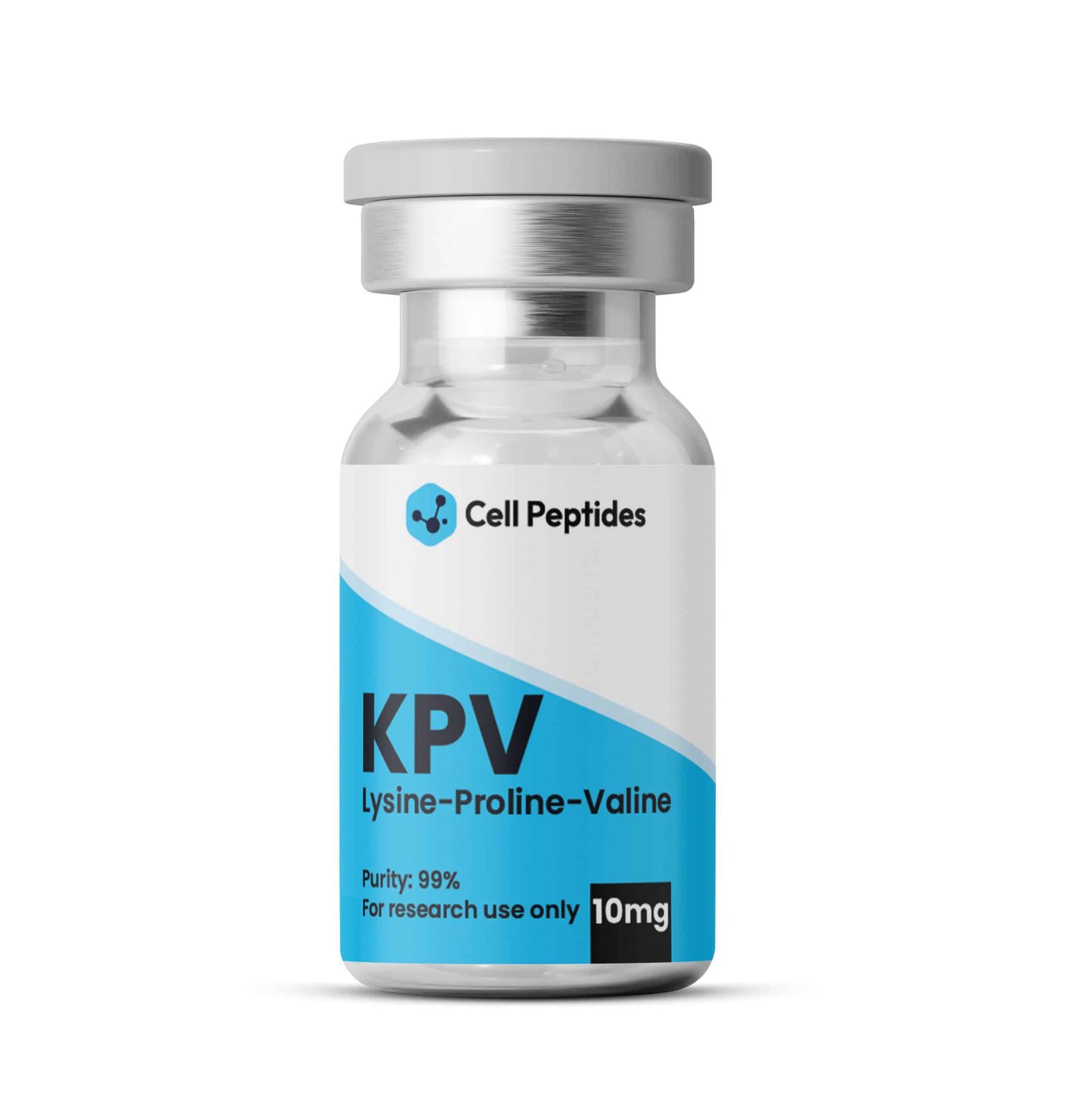
For subcutaneous administration, KPV is supplied as a lyophilized powder — just like the peptide you’re browsing right now. This dry form needs to be reconstituted to prepare it for research. That’s done with bacteriostatic water for use in multi-dose studies — often chosen because it avoids wasting valuable peptides.
The appropriate amount of BAC water (for example, 2 mL for a 10 mg vial) is injected (slowly!) into the KPV vial by angling the needle at the vial wall. Researchers then swirl or roll it. (Shaking agitates the peptide.) Once ready, reconstituted KPV can safely be stored in the fridge for multi-dose use, usually for ~30-60 days.
As usually, don’t hesitate to take a look at our peptide calculator here. Especially, if you find it hard to calculate the correct concentration of the peptide.
Scientific References
- https://www.sciencedirect.com/science/article/abs/pii/S0022354917301740
- https://ard.bmj.com/content/66/suppl_3/iii52.short
- https://www.cell.com/molecular-therapy-family/molecular-therapy/fulltext/S1525-0016(16)45431-6
- https://academic.oup.com/ibdjournal/article-abstract/14/3/324/4653598
- https://onlinelibrary.wiley.com/doi/full/10.1111/exd.13887



 Cart is empty