Why Choose CellPeptides for Your Cagrilintide Research?
Studying Cagrilintide? You know the latest advances in metabolic health don’t happen in a vacuum. Combination research is the future. CellPeptides provides the compounds you need for a complete research ecosystem. CellPeptides synthesizes your Cagrilintide and its potential co-combatants (like Tirzepatide or Semaglutide) — so you can count on consistency as you begin your research.
Why us? We:
- Synthesize your peptides in a WHO/GMP and ISO 9001:2015 certified lab in the EU, to ≥99% purity — research-grade and ready to power your next discovery.
- Subject our Cagrilintide to independent testing, with CoAs for you to review. (So you can study results, not impurities!)
- Ship globally — quickly, securely, and across the globe. With tracking and insurance.
- Take “flexible payment options” a step further. You’re absolutely welcome to pay by credit card or bank transfer, but we also accept cryptocurrency.
- Get it — metabolic research is complex. The CellPeptides support team can handle all your questions. About your order, yes, but also about the peptide or even your study design.
What Is Cagrilintide, and What Makes This Peptide Interesting for Research?
Its most obvious research potential squarely sits in the fields of obesity, weight loss, and type 2 diabetes, yes, but Cagrilintide isn’t a GLP-1 agonist. That’s what makes it interesting.
This peptide is the synthetic version of amylin — stabilized to go the distance. Natural amylin only has a circulating half-life of about 20 minutes, but Cagrilintide was designed to last a whole week.
Amylin is the hormone that the pancreas sends out (alongside insulin) every time you eat something. Once in circulation, it gives the appetite centers in the brain a strong “stop eating now!” message, keeps food in the stomach longer, and keeps glucagon levels down. (That’s the hormone that makes blood sugar spike.)
You’re not weird for experiencing deja vu here — GLP-1 peptides do all that, too. They work on a different pathway, though, and that’s precisely why Cagrilintide has such massive potential. Cagrilintide and GLP-1 receptor agonists both get impressive results on their own. But together? They make the previously impossible happen. As you can imagine, that’s led to some very exciting research already.
The Most Exciting Cagrilintide Research So Far — and a Glimpse of What’s to Come
Phase II trials show that losing more than 10 percent of your starting body weight is possible with Cagrilintide — results comparable to first-gen obesity medications. That alone makes the peptide impressive, but it gets more interesting. More recent studies also point to other benefits. Curious? Read more here.
Cagrilintide for Weight Loss (Alone, and as a Team Player)
You’ve already heard the most common talking point — as per clinical trials, the highest dose of 4.5 mg allows people who suffer from obesity to lose 10.8 percent of their starting body weight after 26 weeks, more than early GLP-1 peptides like Liraglutide could achieve. [1]
So far, so good. But combination therapy is even more interesting. Semaglutide and Cagrilintide get similar results, but in different ways. Studies demonstrate that the two get stuff done that neither manages alone. Semaglutide reduces appetite. Cagrilintide does the same. Semaglutide + Cagrilintide, as a combo, positively tames it. Weight loss results of 17 to 18 percent prove that this dual-hormone approach works. [2, 3]
Blunting Metabolic Adaptation for Sustained Weight Loss
It’s a well-known phenomenon, and a very effective one — rapid weight loss pushes the whole body to fight back as it struggles to hold on to that weight. It does that by slashing energy expenditure, which is what’s called metabolic adaptation.
The mechanism makes evolutionary sense. It gave people in “feast or famine” situations higher odds of survival, but it’s now a threat to long-term weight loss. Metabolic adaptation essentially forces obese people to swim against the tide. In plain English, losing weight is so much easier than keeping it off.
This is perhaps the biggest thing standing in the way of long-term success with weight loss peptides — but Cagrilintide might just have an answer. Rodent studies show that Cagrilintide blunts metabolic adaptation and keeps energy expenditure up. [4] The potential is massive. As is the hope that Cagrilintide might make long-term weight loss possible.
Cagrilintide in Type 2 Diabetes Research
Its weight loss success has definitely drawn most attention, but Cagrilintide has clinical potential beyond that, too — trials show that the peptide leads to significant glycemic improvements. Most notably, one Phase II trial demonstrates that HbA1c and fasting plasma glucose outcomes are better with Cagrilintide + Semaglutide than with Semaglutide on its own. Its post-meal glucagon action counteracts the risk of dangerous blood sugar spikes, and the associated weight loss results simultaneously lead to better insulin sensitivity. [5]
Hope for Reduced Stroke and Heart Attack Risk
You won’t find too many studies about the cardiovascular benefits of Cagrilintide just yet, but there are some. And that early data? It’s pretty promising. Cagrilintide leads to lower blood pressure, lower triglyceride levels, and lower LDL cholesterol — all results strongly associated with better cardiovascular outcomes, including less of a risk of heart attack and stroke. Future research will zoom in on this further, but it makes sense. Significant weight loss is well-known to improve heart health.
Who Might Consider Researching Cagrilintide?
This question answers itself. Cagrilintide is of interest to researchers excited about next-gen metabolic therapeutics across the world. Its amylin-based mechanism means Cagrilintide is an obvious candidate for any lab studying combination therapy with GLP-1s.
Should Cagrilintide get a spot on your lab roster? Definitely, if you’re researching:
- Treatments for obesity and weight loss — some studies look at Cagrilintide as a stand-alone therapy, but increasing numbers research it in combination with Semaglutide as a dual-peptide therapy.
- Type 2 diabetes. Better blood sugar control is one aspect of the potential, but so is managing comorbidities. Research into treatments that manage T2D and obesity at once is among the most exciting right now.
- The cardiovascular risks associated with obesity; an area where there’s still a lot to be discovered about Cagrilintide.
- Perhaps most exciting, to what extent Cagrilintide can fight metabolic adaptation and keep lost weight off for the long haul. GLP-1 peptides have impressive results. Semaglutide + Cagrilintide is even more promising in some contexts. Long-term weight loss that’s actually sustainable is without a doubt the next frontier.
Cagrilintide is for researchers who want more. More weight loss. More durable outcomes. More cardiovascular risk reduction. More breakthroughs.
Common Dosing Protocols for Cagrilintide In In-Vitro Research Setting
Clinical data isn’t in short supply — and that gives researchers established frameworks to base their study designs on. Human trials give the clearest, cleanest data.
In a monotherapy context, doses of 0.5mg to 4.5 mg (delivered once a week via subQ injection) are effective. Studies escalate the dose slowly. They may start with 0.5 mg, for example, and then take the dose up to 0.5, 1.5, and 2 mg — until the final dose is reached.
Multi-peptide studies usually opt for Cagrilintide 2.4 mg + Semaglutide 2.4 mg. Doses of both can be lower, because the two work together.
Feel free to use our peptide calculator here in order to find out the correct dosage concentrations based on how much BAC water was dilluted with the Cagririlintide.
How to Reconstitute the Peptide?
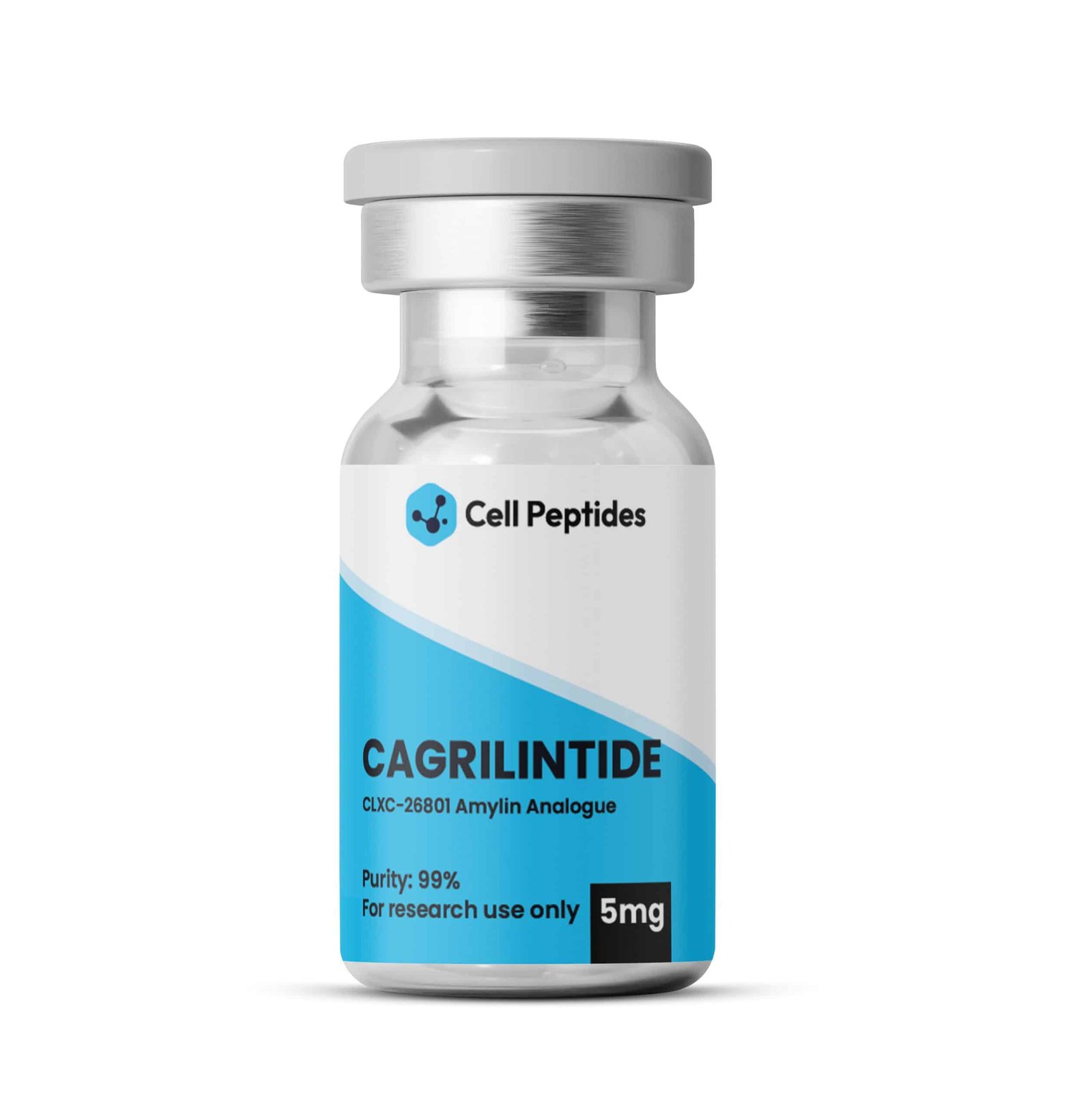
CellPeptides provides lyophilized Cagrilintide. Bacteriostatic water or sterile saline are the only sterile solvents that can be used to reconstitute it to get it ready for use — but bacteriostatic water is the most obvious candidate, since it makes the peptide available for multi-dose studies so long as it’s refrigerated.
This process is the same across peptides. Peptides easily become denatured, so researchers point the needle filled with the right dose of BAC water at the vial wall (and not into the powder). When injected, the next step is rolling the vial between two hands to mix it. Swirling also works, as long as researchers take care not to let that cross over into shaking.
Scientific References
- https://www.thelancet.com/journals/lancet/article/PIIS0140-6736(21)01751-7/abstract
- https://journals.lww.com/cardiologyinreview/fulltext/2024/01000/cagrilintide__a_long_acting_amylin_analog_for_the.13.aspx
- https://www.nejm.org/doi/abs/10.1056/NEJMoa2502082
- https://www.nature.com/articles/s42255-025-01324-8
- https://www.thelancet.com/journals/lancet/article/PIIS0140-6736(23)01163-7/abstract


 Cart is empty