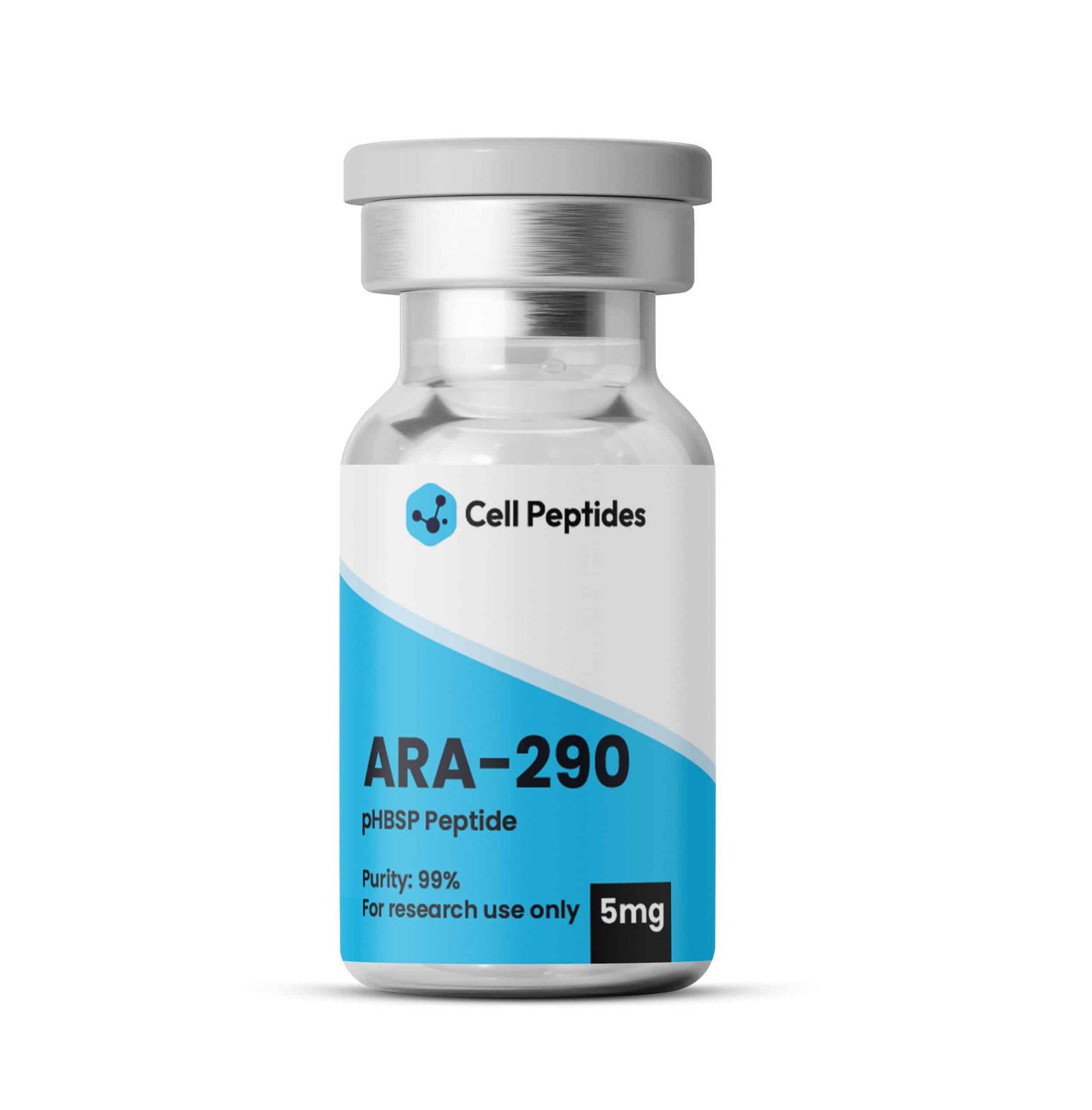
Why Choose CellPeptides for Your ARA-290 Research?
Zapping the dangerous side effects of EPO is the whole reason ARA-290 was developed — and you don’t want your research to be undermined by a questionable supplier. CellPeptides makes your scientific breakthroughs possible with pure, reliable, research-ready peptides. Our ARA-290 is:
- Made in a WHO/GMP and ISO 9001:2015 certified lab — ≥99% and ready for your next study.
- Backed by independent lab testing, so you can review our certificates of analysis to check composition and purity.
That’s the foundation — the minimum you need to protect the integrity of your ARA-290 research and the safety of your model. Other reasons to choose CellPeptides? We ship peptides globally, quickly, and securely, with insurance and tracking. We’re flexible about payment methods. Credit cards and bank transfers are fine with us, but we also accept crypto.
Perhaps even better? We’re the people who make your ARA-290, so we know a lot about the compound. Our support team will get all your questions answered, whether they’re about your order or your study design.
How Does ARA-290 Work, and What Makes This Peptide Interesting for Research?
You already know the basic idea behind ARA-290 — all of the anti-inflammatory and repair benefits of EPO, with none of the side effects that are, for most people, rather dangerous. EPO does have some clinical use, though, namely as a treatment for anemia related to chronic kidney disease.
It was that use that allowed researchers led by Dr Anthony Cerami to observe that these patients very often noticed pain reduction and better health. A huge clue! That observation meant that EPO had to be doing something scientists didn’t previously know about. Something besides making red blood cells. It was clearly sending anti-inflammatory and reparative signals — and strong ones at that.
What was that, and could that be bottled? Finding out was the next mission. Much research and tweaking later, and they isolated a selective peptide that only activates the IRR, the innate repair receptor responsible for the anti-inflammatory, healing benefits of EPO.
Countless studies published so far show that it’s well tolerated with an excellent safety record. Those studies in no way close the door on further research, though. In fact, current research probably only shows the tip (or even the tip of the tip) of the iceberg. Any condition rooted in inflammation, nerve damage, or cell repair gone wrong is ripe for ARA-290 research.
The Ever-Expanding Applications of ARA-290 in Research: From Inflammatory and Autoimmune Conditions to Wound Healing
ARA-290 uses foundational natural pathways to slash inflammation and boost cell survival — and the amazingly diverse conditions that could benefit from exactly that mechanism explain both the number and range of studies done so far. The most interesting finding? Take your pick!
ARA-290 Research Into Wound Healing and Surgery Recovery
ARA-290 doesn’t directly build or repair tissue, but it does create an optimal environment for healing. The peptide does that by managing the early inflammatory phase of wound healing — and making sure excessive, damaging inflammation doesn’t have a chance to set in. It does something else that’s very important, too. ARA-290 boosts new blood vessel formation, so the area around a wound is properly supplied with oxygen and nutrients. [1]
Those properties have made for interesting studies with promising results. Diabetic foot ulcers, for which no great treatment options exist at the moment, and which come with a significant risk of infection and amputation, have been especially extensively studied so far. ARA-290 speeds healing up — and that can make the difference between losing a foot and keeping it. [2, 3] Future studies are bound to zoom in on other hard-to-heal wounds, as well as incision healing after surgery.
Small Fiber Neuropathy — Less Pain, More Healing
Small fiber neuropathy isn’t exactly a household name, but it’s a nightmare for people who suffer from this form of peripheral neuropathy related to conditions including diabetes and sarcoidosis. Damaged small nerve fibers in the skin cause all sorts of nasty symptoms — burning, tingling, and sensory disturbances are all on the list. Even worse? Small fiber neuropathy can also strike nerve fibers that regulate blood pressure and heart rate.
ARA-290 has been very well studied in this area, including in human trials. The results? The peptide rebuilds nerve fibers, reduces pain, and improves sensory perception. It zooms in on the root cause — which beats the most common treatment for the condition, painkillers. [4, 5]
ARA-290 for Organ Protection
The anti-cell-death messages ARA-290 sends out make the peptide an obvious candidate for research into recovering from ischemic injury, where lost blood flow causes damage to organs. Studied so far? Kidney injury (ARA-290 reduces inflammation and scarring), cardioprotection (the peptide fights inflammation within heart tissue), and traumatic brain injury (the EPO-derived compound blocks cell death). More resilient organs that recover from stress more quickly are, of course, interesting outside of the context of injury, too — and studies have already identified ARA-290 as a compound that can fight so-called “inflammaging” for better health in later life. [6, 7]
The Potential in Managing Autoimmune Diseases Like Lupus and MS
It’s no surprise that research into ARA-290 has also zoomed in on autoimmune diseases — they’re intrinsically caused by an immune system turning on its host and going to war on essential tissues rather than pathogens. Could ARA-290 bring things back into balance and fight excessive inflammation?
The answer is “yes.” Studies show that ARA-290 reduces organ damage and disease activity in lupus patients [8], while protecting neurons and myelin-making cells in multiple sclerosis [9]. It’s still too early to translate these successes to clinical settings, because the patients were, in these cases, mice. Still exciting — and a great foundation for future research.
Who Might Consider Researching ARA-290?
A peptide that regulates inflammation, protects nerves and other tissues, and speeds up healing has obvious appeal in a massive range of fields — and ARA-290 makes studies that would have posed too high a risk with unmodified EPO possible.
Does your work center on neuropathy? Chronic pain? Wound healing? Or perhaps autoimmune and inflammatory diseases, or even neurodegenerative conditions like Alzheimer’s or Parkinson’s? Or organ protection?
You don’t have to research ARA-290 if you research any of these areas, but the peptide at least deserves your consideration. Research to date has been impressive already. Researchers have plenty to build on, but also countless new discoveries to make.
Common Dosing Protocols for ARA-290 In-Vitro Research Setting
A whole body of preclinical research and phase I and II clinical trials makes establishing dosing protocols significantly easier. Despite that head start, everything about a new study — from the model to the research goals and delivery method — impacts the decision.
Curious what you’ll see when you review the literature? This quick overview should get you started:
- Dosing for studies using subcutaneous and IP delivery in rodent models very often ranges from 30 µg to 100 µg per kg of body weight — and ARA-290 might be administered once or twice per day.
- A daily subQ dose of 0.5-4mg is common in human trials for neuropathy.
- In vitro studies have more varied ranges. Doses between 0.1 nM and 100 nM aren’t uncommon.
The dose and delivery should match the research goals, and subcutaneous delivery is best suited for studies that observe the systemic effects of ARA-290. Acute studies usually run for up to two weeks, while research into long-term effects may feature study designs that last four weeks to six months.
Researchers prepare lyophilized ARA-290 for research by reconstituting it. Choosing bacteriostatic water over sterile saline makes multi-dose research possible — and with that, longer studies. Peptides reconstituted with bacteriostatic stay stable in the fridge between 2 and 8 °C, usually for around 28 days.
Prepare ARA-290 for study by slowly injecting BAC water (eg: 2 mL for a 5 mg vial) and aiming the needle at the vial wall. Roll or swirl until it’s clear, and always be careful not to cross the line into shaking. That upsets peptides and puts their structure at risk.
Feel free to use our peptide calculator here to find out the correct and exact ARA290 dosage based on how much BAC water was added.
Scientific References
- https://journals.lww.com/shockjournal/abstract/2016/10000/ara290,_a_specific_agonist_of_erythropoietin_cd131.8.aspx
- https://link.springer.com/article/10.2119/molmed.2014.00215
- https://www.sciencedirect.com/science/article/pii/S0925443917304556
- https://medicalantiaging.com/wp-content/uploads/2024/12/MAA-Cibinetide.docx.pdf
- https://iovs.arvojournals.org/article.aspx?articleid=2625918
- https://www.nature.com/articles/s41419-020-2276-8
- https://link.springer.com/article/10.1007/s13311-015-0418-y
- https://onlinelibrary.wiley.com/doi/full/10.1111/jcmm.13608
- https://www.sciencedirect.com/science/article/abs/pii/S0165572814000095


 Cart is empty