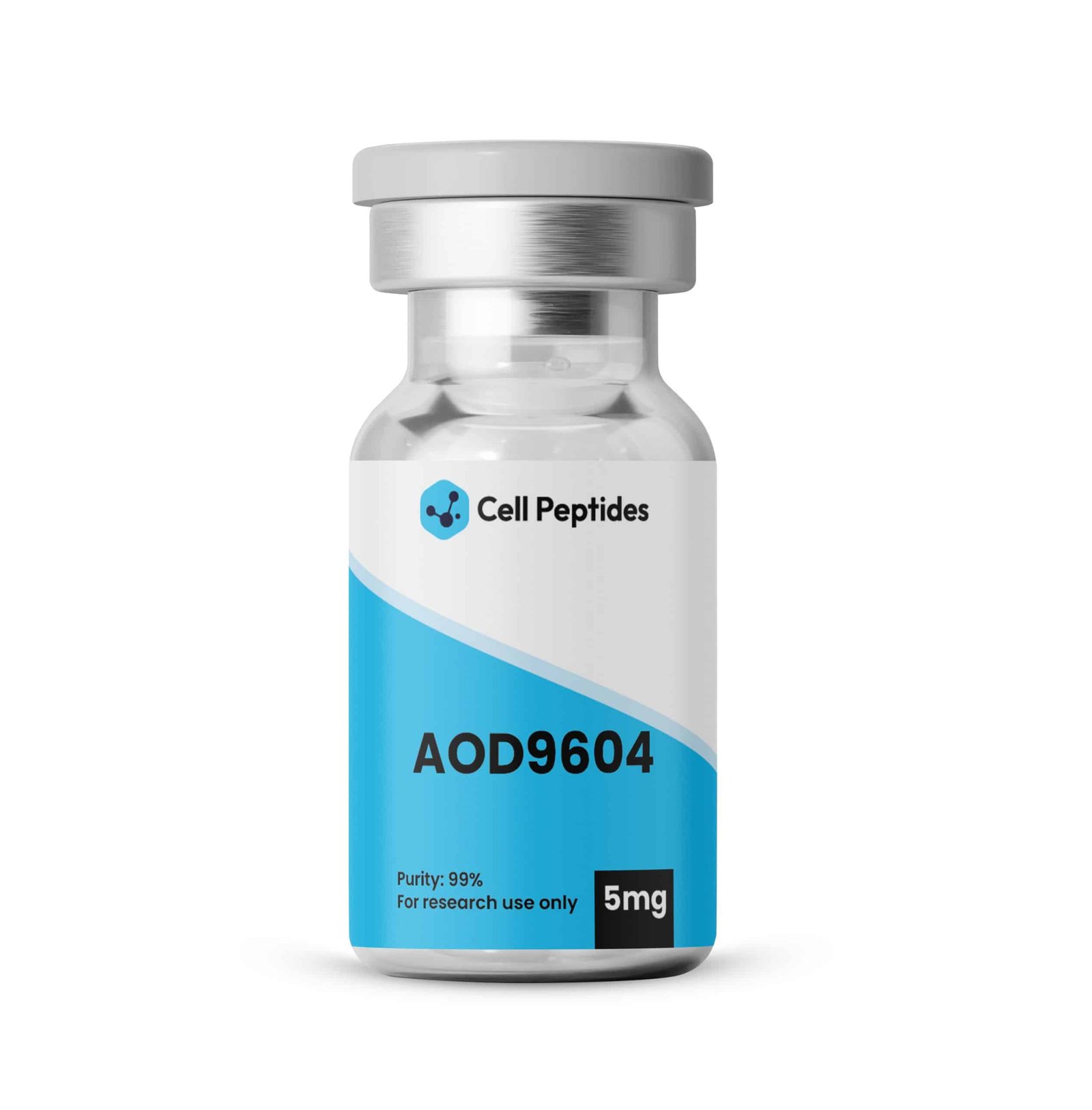
Why Choose CellPeptides’ AOD9604?
It’s not just that AOD9604 is hard to make (although it is), but also that it’s a very specific modified fragment. It takes no more than a missing disulfide bridge or amino acid to turn AOD9604 into a completely different compound. There’s zero margin for error — and the quality of your research starts right at the beginning. When you choose where you order AOD9604.
We’re a scientific and research company based in EU, and our AOD9604 is made to meet your research standards:
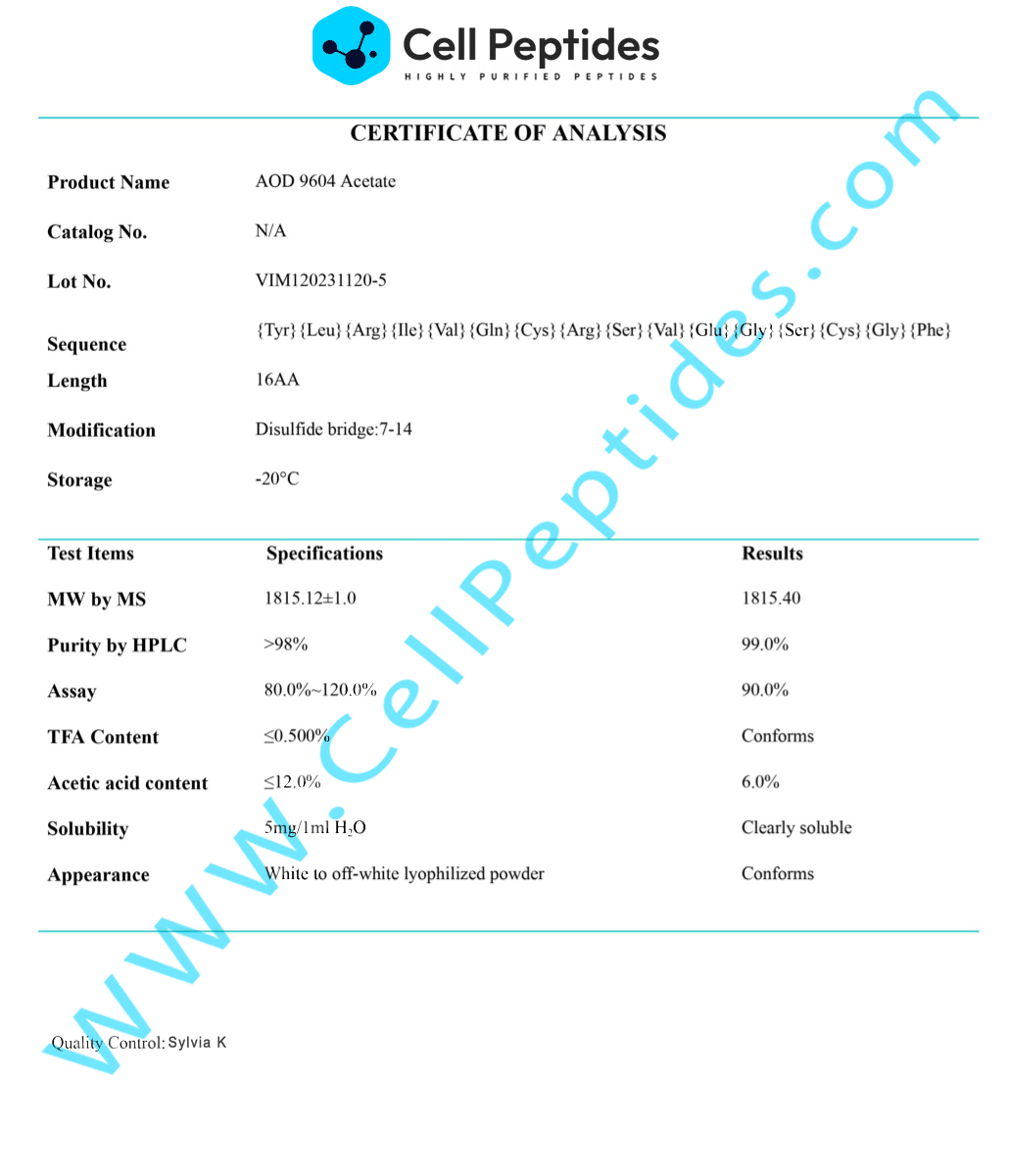
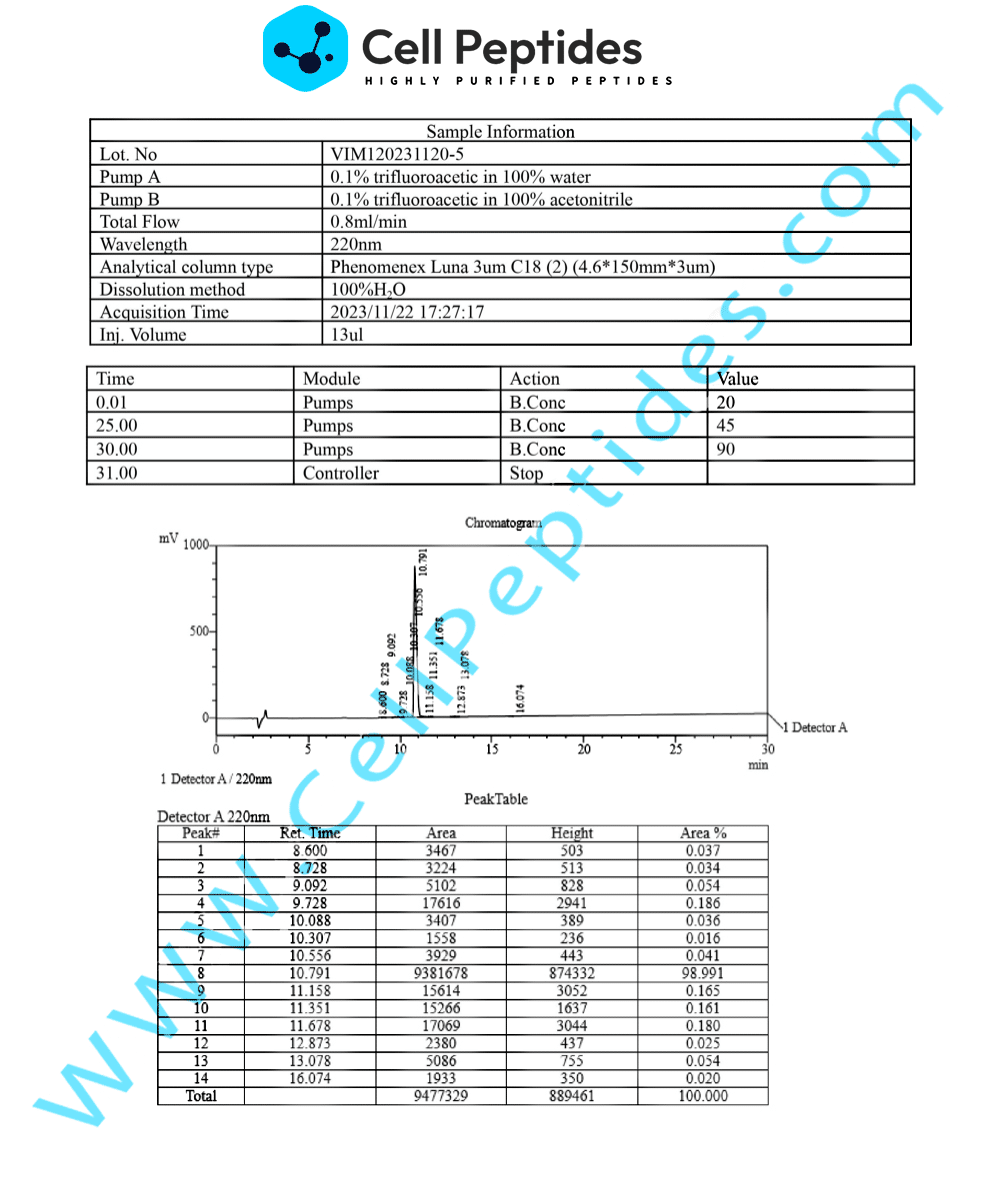
- It’s manufactured to ≥99% purity — research-grade and ready for serious investigations.
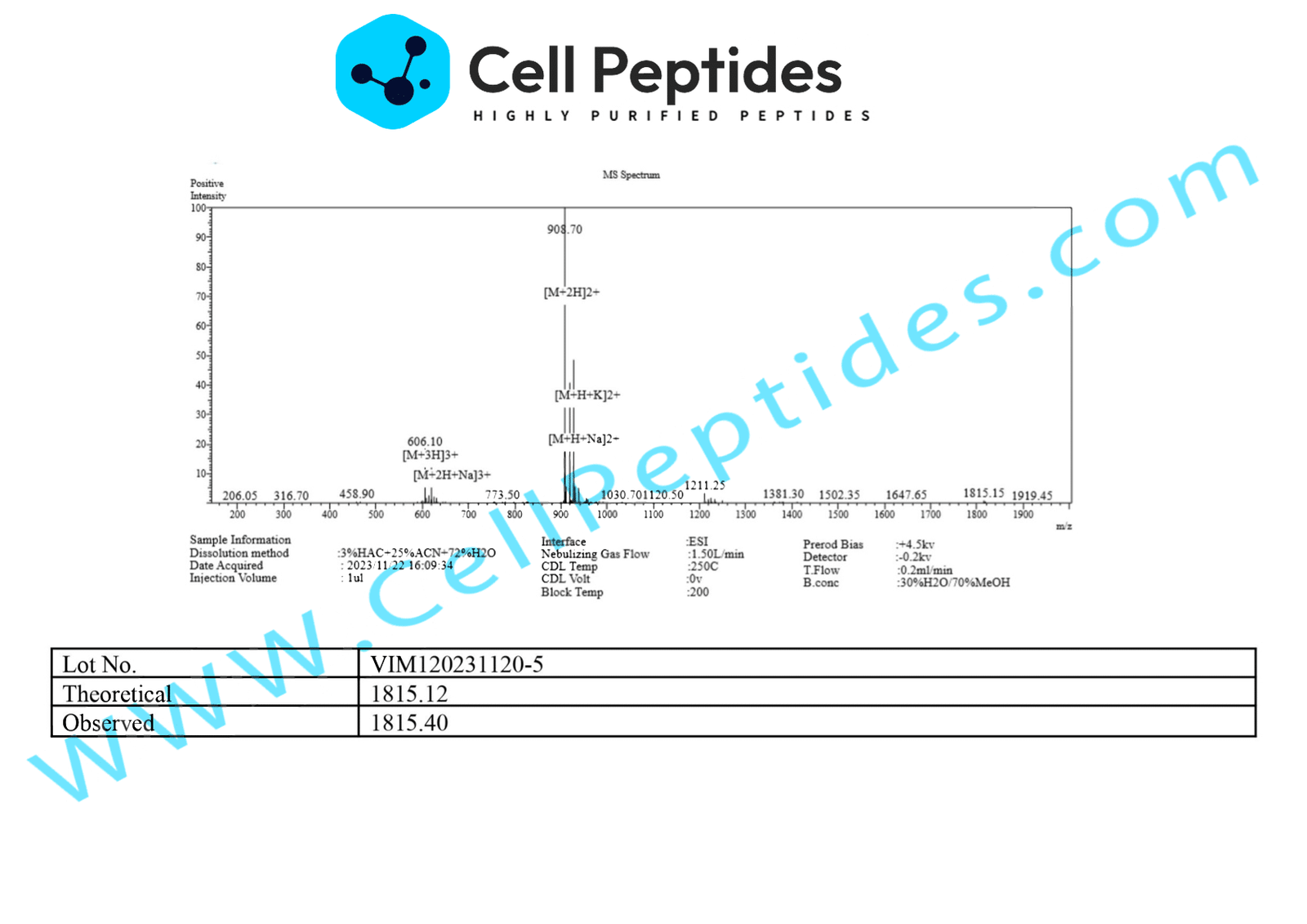
- We subject all our peptides to regular third-party lab testing. Want to review the latest certificate of analysis to check purity and composition? You should and you can.
- Shipped safely in discreet packaging — globally, with insurance and tracking, and fast.
Still got questions? CellPeptides will get them answered, whether they’re about your order or your research design. (No need to ask if we accept crypto, though. We do.)
How Does AOD9604 Work?
Human growth hormone — which researchers in the fitness or bodybuilding space are already intimately familiar with — is a serious multi-tasker. It plays parts in processes as diverse as growth, muscle building, metabolism, and tissue healing, and it’s commonly studied for all of those things.
Sometimes, though, research zooms in on just one area. That’s when AOD9604 comes in handy. This biomimetic was lab-designed to replicate the C-terminal region (amino acids 176-191) of the hGH molecule. That’s the part with the job description of “fat burning.”
It’s got a two-part mechanism. AOD9604 tells fat cells to break triglycerides into free fatty acids and glycerol — so they can get used for energy (and disappear). The precise way this works isn’t quite clear yet, but research done to date suggests it happens by switching beta-3 adrenergic receptors on. These attack fat.
The second part of how AOD9604 works is just as important. While it’s at work attacking existing fat cells, the peptide also sends out signals that prevent more from being formed. This is almost more interesting, because keeping weight off is often just as hard as losing it in the first place.
Also interesting? Current research shows that AOD9604 is exceptionally safe. It’s a targeted signal that doesn’t touch the parts of growth hormone associated with side effects, and that makes it all the more promising for future studies.
The Potential Use Cases for AOD9604: What the Research Has Discovered So Far
AOD9604 was explicitly designed with the singular goal of stimulating fat loss in the treatment of obesity. Research into this use case reached the human trial stage, and researchers demonstrated that AOD9604 has an exceptionally good safety profile over the course of these trials.
Following the science has also led to completely different potential applications for AOD9604, though — and they’re just as interesting.
AOD9604 in Obesity Studies — The OG Purpose
Obesity treatment was the original purpose of AOD9604, something that’s also reflected in its full name — Anti-Obesity Drug 9604. Research started with animal models, which established its safety to the point that human trials got started, too. Studies done so far (and there are many!) have all found that AOD9604 is a targeted, “clean” growth hormone fragment that triggers lipolysis and prevents new fat cells from growing without having any of the effects of unmodified GH. [1, 2]
As for raw power, AOD9608 doesn’t lead to the same impressive weight loss results as, for example, Semaglutide or Tirzepatide — but it does improve metabolic markers like cholesterol levels.
Targeted Fat Burning (Beyond Obesity)
That gentler action puts AOD9604 into an interesting category, where it doesn’t only have potential as a weight loss peptide for treating overweight and obesity, but also for stubborn fat deposits in non-obese subjects. These fat stores resist exercise and diet — and eliminating them is of special interest in bodybuilding and other athletic research. [3] So far, AOD9604 appears to be especially good at targeting visceral fat (the dangerous kind), because of its action in relation to beta-3 adrenergic receptors. [4]
AOD9604 for Osteoarthritis and Joint Health
This is where AOD9604 gets really interesting. A peptide designed for fat loss promotes fat loss? More or less “what it says on the tin.” But as often happens in peptide research, AOD9604 has turned out to have an entirely different application too — in joint health.
Numerous animal models have shown that the peptide stimulates cartilage regeneration while pushing inflammation down. Cartilage is, of course, among the slowest tissues to heal, so this application is important. AOD9604 seems to do this by boosting the production of the components needed for cartilage, notably proteoglycans and collagen. [5]
Treatment of osteoarthritis via local injections is one of the most promising potential future clinical applications, but studies have also looked at AOD9604 for osteoporosis treatment — with equally positive results. [6]
Cardiovascular Health Improvements Seen with AOD9604
Metabolic and cardiovascular health are closely linked — and it’s well known that improving the first will also lead to better outcomes in the second area. It’s not at all surprising, then, that some studies have found AOD9604 to be associated with healthier cholesterol and triglyceride profiles. [7] There’s also interest in the possibility that the peptide directly improves vascular health, but that’s still an emerging scientific field of inquiry.
Who Might Consider Researching AOD9604?
The fact that AOD9604 doesn’t bind to growth hormone receptors, and targets a precise pathway related to metabolic health, means it’s most interesting to researchers in the fields of obesity treatment and targeted fat burning, notably visceral fat and body composition improvements.
AOD9604 might be perfect for your lab if you’re researching:
- Lipolysis — not only in the context of obesity, but also body composition optimization, including in bodybuilding studies.
- Joint health, because promising results have been seen in osteoarthritis and osteoporosis. Cartilage injuries are another obvious study area.
- The connection between metabolic and cardiovascular health.
This selective peptide has already been studied in all of these areas, but the most exciting breakthroughs are still waiting for the right science team. Maybe yours?
Common Dosing Protocols for AOD9604 In Research In-Vitro Setting
Dosing in published AOD9604 preclinical and human studies is variable, as it is determined by both the model and the research goals. A review of existing literature is always a good starting point for a new study design, and sufficient research has been done to allow for plenty of insights. Doses often cited range from 200 to 500 mcg (micrograms) administered daily, although some go up to 1000 mcg. Initial doses are lower to allow researchers to observe the model’s initial response. That said, AOD9604 has an exceptional safety profile.
The lyophilized AOD9604 provided by CellPeptides needs to be reconstituted. For use in multi-dose applications, that is done with bacteriostatic water. Lab protocols aren’t optional — wipe the rubber stoppers of both vials with alcohol wipes, angle the needle at the vial wall, slowly inject BAC water, and then roll or swirl until the solution is clear. AOD9604 will then stay stable between 2 and 8 °C for multi-dose use, in most cases up to 30-60 days.
To find out the correct dosage for your model – you can use our comprehensive peptide calculator here.
FAQs
How long can researchers expect to wait before they can observe results with AOD9604?
That time frame depends on both the model and the goal — because fat loss and cartilage regeneration are not the same. The research design also impacts it. Data should generally be collected over a period of at least several weeks before it becomes possible to adequately measure the response.
Can AOD9604 cause weight gain?
The opposite effect — fat and weight loss — is at once the main purpose of AOD9604 and its observed effect in research. Some growth hormone peptides are researched for weight gain (“bulking”), but AOD9604 is a fragment that eliminates this effect.
How does AOD9604 compare to hGH?
The full and natural hormone binds to the growth hormone receptor, where it produces a range of effects. AOD9604 is a fragment that solely isolates effects related to fat metabolism.
What is the observed effect of AOD9604 on belly fat?
Studies that have looked at abdominal fat stores have found a reduction in waist circumference. AOD9604 is designed to fight all fat stores, including belly fat.
Scientific References
- https://jofem.org/index.php/jofem/article/view/157
- https://www.researchgate.net/profile/Jason-Halford/publication/7154334_Obesity_drugs_in_clinical_development/links/09e4150694f5675e10000000/Obesity-drugs-in-clinical-development.pdf
- https://imtj.gmu.ac.ir/browse.php?a_id=3621&sid=1&slc_lang=en&html=1
- https://onlinelibrary.wiley.com/doi/abs/10.1111/obr.12163
- https://www.annclinlabsci.org/content/45/4/426.short
- https://utoronto.scholaris.ca/items/1ab5818e-ccf6-4a4b-a7cf-c4e0a75f186e
- https://onlinelibrary.wiley.com/doi/full/10.1038/oby.2006.294


 Cart is empty