Why Choose CellPeptides’ Adipotide?
Adipotide is a complex, hard-to-synthesize experimental compound. Making it takes expertise — and technology. The quality of your research stands and falls with its structural integrity, so you need a research and scientific company that gets it right. That’s CellPeptides. We’re based in EUand our lab is WHO/GMP and ISO 9001:2015 certified.
When you order from us, you benefit from:
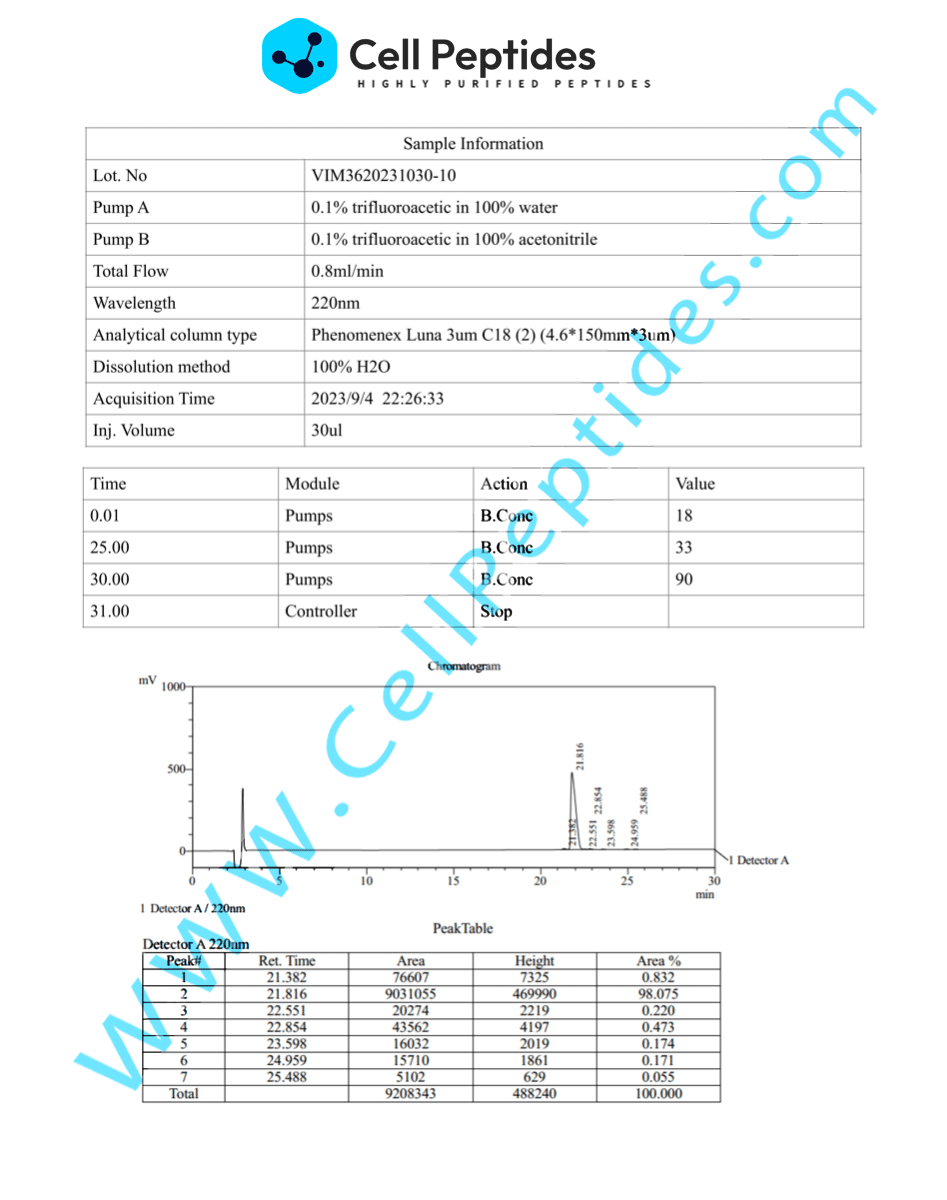
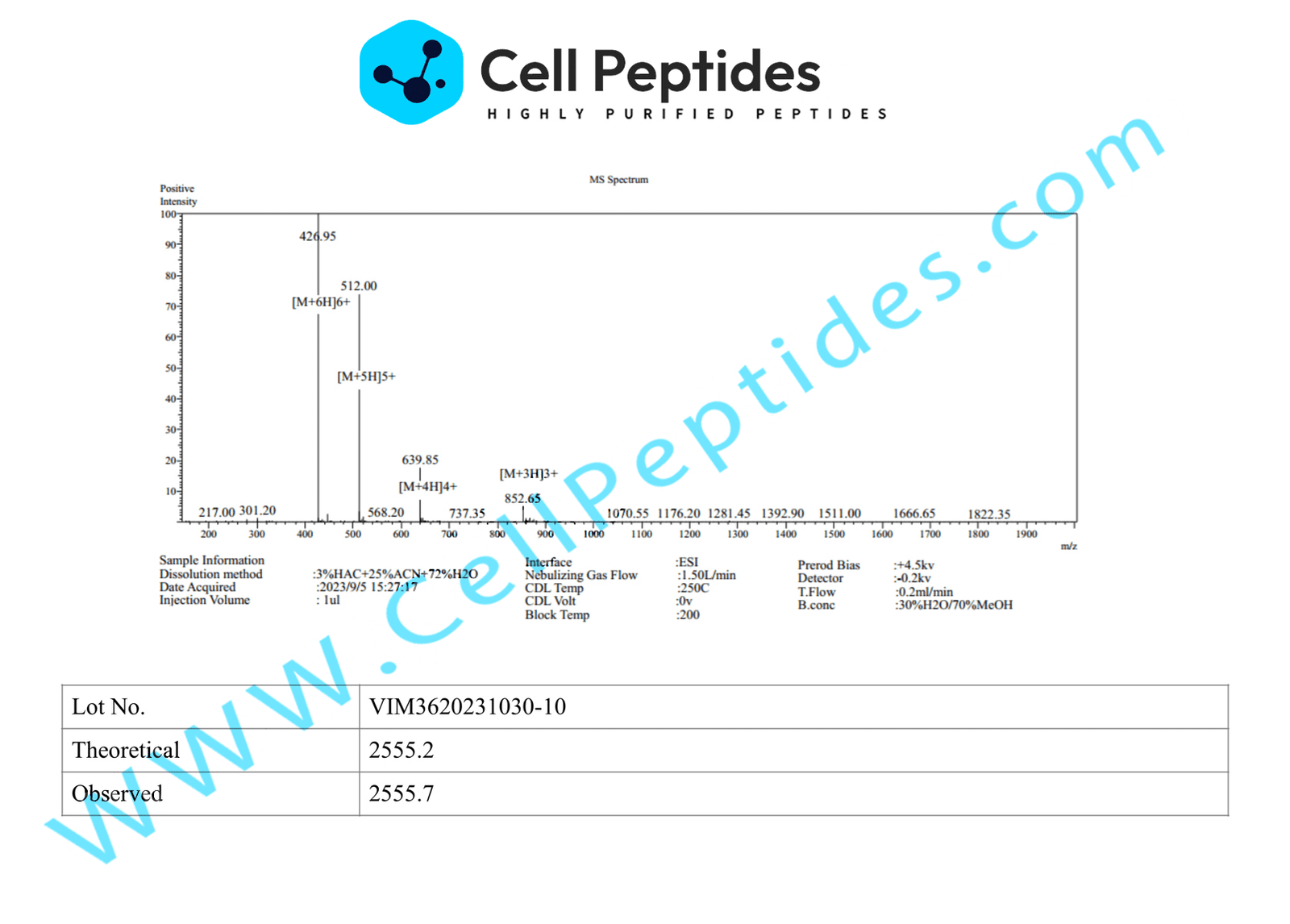
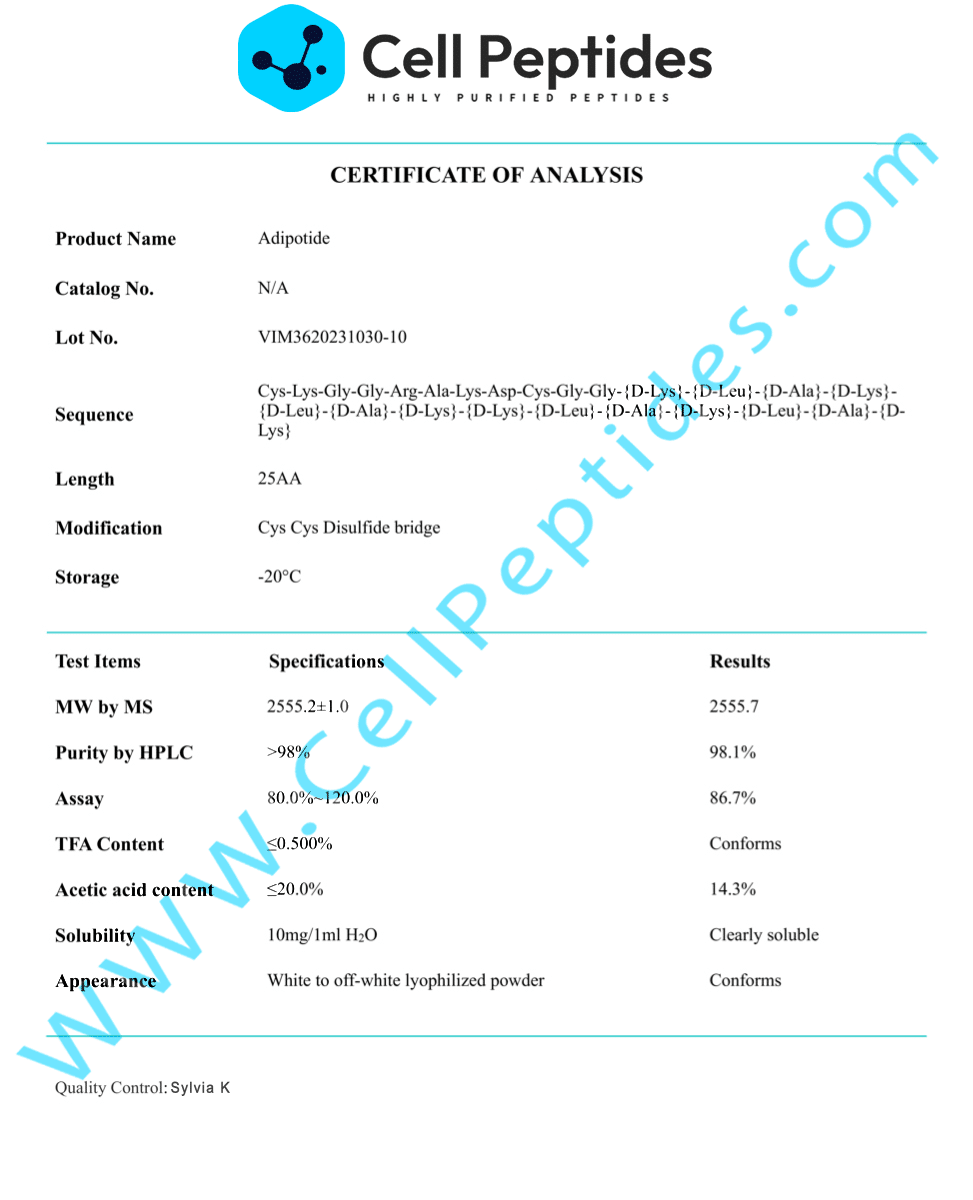
- Research-grade purity — nothing less than ≥99%. Unknown impurities invalidate your research. Don’t tolerate them.
- Certificates of analysis that confirm composition and purity.
- Safe global shipping that ensures the stability of your compounds.
- Flexible payment options — bank transfers, credit cards, and cryptocurrency are all fine with us.
Your Adipotide research is nothing short of groundbreaking. Got any questions? Want to run your study design by a team that understands how exciting it is? We’re here, and our support team is pretty knowledgeable. (We make the compound that will go on to power your scientific discoveries, after all!)
How Does Adipotide Work?
It’s not elegant — but it is effective. Proof-of-concept studies in obese mice and later rhesus monkeys demonstrated impressive weight loss (11 percent in just 30 days for the monkeys!), serious drops in abdominal circumference, and improved insulin sensitivity.
Adipotide’s mechanism of action is nothing like Semaglutide’s or Tirzepatide’s. It doesn’t work by keeping appetite down or speeding metabolic processes up. Instead, it starves fat cells — specifically, white adipose tissue of the nutrients and oxygen they need to keep existing.
It’s a two-stage process. First, Adipotide binds to the protein prohibitin. The cells that line the blood vessels responsible for supplying fat tissue are covered in it — but other blood vessels not so much. Then, it goes to war with the mitochondrial membranes, essentially forcing those blood vessels into a self-destruct sequence.
Fat cells, now robbed of their lifeblood, get reabsorbed. Never to be seen again.
No natural peptide has the same function. Adipotide wasn’t copy/pasted from Mother Nature. It was engineered to prune blood vessels in a very targeted way. Amazing? We certainly think so. The research potential is obvious. It is immense. And it’s exciting, all the more so because Adipotide studies are still in their early phases.
Early Adipotide Research in Weight Loss and Insulin Sensitivity: The Evidence So Far
The mechanism of action isn’t the only impressively interesting thing about Adipotide. Observed outcomes in early models are just as worth reading about. The existing body of science has taken Adipotide out of the conceptual, hypothetical realm into the domain of hard science — with amazingly quick results in animal models. Curious? Wait until you hear about the findings.
Adipotide Leads to a Dramatic Reduction in White Adipose Tissue
That’s the dangerous kind, the kind that appears all over the body — as bone marrow fat, visceral fat, and subcutaneous fat. Adipotide was designed to destroy it, and early research shows it does exactly that. When the compound declares war on the vasculature that supplies fat stores, it takes them out.
The first Adipotide studies were done on obese mice. Those mice lost weight. Quickly. But they also enjoyed improved health outcomes as the secondary effects of obesity (the lingering metabolic effects) were reversed. Research then continued with rhesus monkeys. They also lost weight. Eleven percent of their starting body weight in under a month, to be precise. [1, 2]
The research showed that zapping white adipose tissue directly leads to impressive weight loss results, while demonstrating the power of Adipotide in action. The results weren’t cosmetic. We’re not talking about “water weight” here — the mechanism by which fad diets usually get such fast results that wear off just as quickly. Adipotide tackles obesity at the root.
Oh, we’re still missing something huge that bears spelling out explicitly, because it’s almost unbelievable otherwise. The animal studies done so far led to these dramatic weight loss results… without a caloric reduction.
That’s not a sustainable model for future obesity treatment in humans, to be sure, but it shows just how effective Adipotide can be.
Improved Insulin Sensitivity in Adipotide Research — The Secondary Benefit
Several peptides now commonly used to treat obesity, notably Semaglutide and Tirzepatide, were first developed as next-gen diabetes treatments. There’s some role reversal going on with Adipotide. American researchers explicitly designed it to kill fat by cutting off its blood supply. Adipotide also, however, has extra benefits.
The landmark rhesus monkey study found that the test subjects had improved insulin resistance and metabolic function. That’s a direct result of reduced white adipose tissue. Losing inflammatory visceral fat restores insulin function — and from there, the path to better health outcomes is very direct. [3, 4]
Obesity treatment is important (2.5 billion people across the globe suffer from this serious metabolic disorder), but these findings suggest potential future applications for Adipotide even beyond it. Future metabolic syndrome and type 2 diabetes studies are very likely to zoom in on the potential of Adipotide.
Who Might Consider Researching Adipotide?
Who would research an extraordinarily aggressive peptidomimetic with a completely new mechanism of action — purpose-built around two natural processes, angiogenesis and apoptosis? Researchers at the cutting edge, of course. Those looking for different answers to very old questions.
Advanced metabolic and obesity research is, of course, grabbing all the attention. If you’re the kind of researcher who asks what it takes to treat obesity with surgical precision — but without bariatric surgery? Adipotide should absolutely be on your radar.
Other kinds of research are taking place, too. Adipotide is interesting to researchers investigating blood vessel development in in vitro settings, oncology studies (tumors depend on blood supply, too), and the way Adipotide and more established weight loss peptides might interact and lead to even more dramatic results.
Regardless of your area of study, one thing is clear. Your research depends on pharmaceutical-grade Adipotide with the potential to replicate the results of the exciting studies done to date. CellPeptides provides the sequence you need for radical breakthroughs, and we hope your study begins with us.
Common Dosing Protocols for Adipotide In-Vitro Research Setting
Your Adipotide study design should always start with a thorough review of existing literature and known side effect profile to help you determine the best dosing protocol for your specific model — and strictly follow ethical standards.
The important studies we looked at earlier calculate dosing based on the body weight of the model, and 0.1 to 3.0 mg per kilogram of body weight is a frequently cited range. Treatment periods have ranged from several days to a full month in these study designs. The method tends to focus on daily dosing. Adipotide has a complex, targeted mechanism that calls for careful ongoing monitoring in in vivo applications.
CellPeptides provides Adipotide in lyophilized form. Researchers prepare it for multi-dose applications by reconstituting the compound with bacteriostatic water (never tap or demineralized water!). Angle the syringe at the vial wall and inject the appropriate amount for your desired concentration slowly. Then, roll or swirl until clear. No shaking! (Patience is a virtue — you’ll get there eventually.) Once done, Adipotide can be used for multi-dose applications if stored between 2 and 8 °C consistently for up to 30-60 days.
Have a technical question about preparing Adipotide for research? Run your research design questions by CellPeptides if you want a second pair of eyes from the team that synthesizes your compounds.
Also feel free to use our free peptide calculator showing how much to draw based on how much BAC water was added.
FAQs
What research has been done on Adipotide so far?
Mostly preclinical, but undeniably impressive. Obese rodents and primate studies proved that Adipotide has the potential to kill fat cells by starving them of their blood supply in practice. These results coincided with dramatic weight loss and metabolic improvements. They’re a good foundation to start further research with.
Do insights into the long-term safety profile of Adipotide exist?
Because Adipotide remains in its early research phases, with new studies still regularly emerging, long-term safety data is not yet available. Preclinical studies assessed the short-term results of Adipotide. Researchers contemplating longer studies need to design their research with strict safety and ethical monitoring.
What are the future prospects for clinical use?
It will take time for Adipotide to move past the preclinical stage, but the potential future applications are squarely in obesity treatment — with metabolic syndrome and type 2 diabetes as additional potential use cases. We’re not there yet, though!
Scientific References
- https://www.science.org/doi/abs/10.1126/scitranslmed.3002621
- https://www.cell.com/ccbio/fulltext/S1074-5521(13)00047-1
- https://www.sciencedirect.com/science/article/abs/pii/S0168365913004070
- https://books.rsc.org/books/edited-volume/532/chapter-abstract/176769/New-Drug-Design-and-Therapeutic-Development-for?redirectedFrom=fulltext



 Cart is empty