
 Cart is empty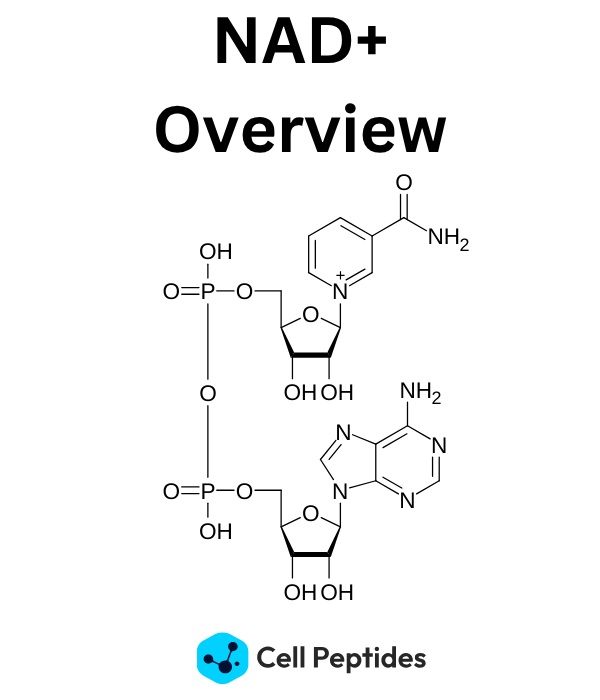
*The below article and information are based on lab research data of NAD+, this is not medical advice in any kind of shape or form.
Wondering why you’re hearing buzz around NAD+ in pretty much every research field — from anti-aging to diabetes, and from brain health and power to endurance in athletics?
There’s a simple reason. Nothing works without this coenzyme. Everything that happens in every cell would just stop without it. NAD+ is a “utility” molecule that works as a courier, power converter, and repair signal. It has a hand in more than 500 different enzymatic reactions. Among them? Those that turn food into energy and make sure your genetic code stays intact.
NAD+ levels don’t stay optimal forever, though. They plummet with age. Relentlessly and dramatically, so that you’ve only got about half by midlife. NAD+ levels don’t “go gently into that good night,” either. They crash. And that crash has cascading effects.
Less energy. Declining cognitive sharpness. Lost endurance. Slower healing and recovery. All these “perfectly normal signs of aging” have something to do with plummeting NAD+, without which cells have trouble doing their basic duties.
The reasons NAD+ has caught the eye of countless researchers don’t need further explanation, then — but with your curiosity piqued, you’ll want to find out more anyway. This is exactly the place to do that.
A Brief History of NAD+ & Its Discovery
The question the British biochemists who discovered NAD+ in the early 20th century had was interesting, but it had little to do with any of the research applications scientists are excited about now. “What about yeast juice turns sugar into alcohol?”
As it turned out, the answer was NAD+ — AKA Nicotinamide Adenine Dinucleotide. After that discovery, NAD+ was mostly known for its part in redox reactions. Its “electron shuttle” job earned Otto Warburg his Nobel Prize in 1931. [1]
Nicotinamide Adenine Dinucleotide later turned out to be more than a one-trick pony, though — although that discovery took a while to materialize. Almost exactly a century after the initial discovery, Dr Leonard Guarente and Dr David Sinclair found out that the coenzyme was also fuel for a class of enzymes — sirtuins. They repair cells, protect DNA, and regulate metabolic processes, and they don’t work without NAD+. [2]
That discovery took NAD+ from fermentation to aging. When age sends NAD+ levels down the drain, sirtuins lose steam, too. That’s when you get cell damage. And the symptoms of aging come along for the ride.
How Does NAD+ Work?
NAD+ does a lot, but it’s got two important full-time jobs that keep bodies everywhere running.
Energy metabolism is the more well-known of these two. NAD+ picks up energetic electrons from nutrients, becomes NADH, and delivers them to the mitochondria. That’s where they get converted into ATP. That entire process, which continues indefinitely, is called cellular respiration. Living, moving, and thinking would all be impossible without it.
Then, there’s the second job. NAD+ is a cofactor for repair enzymes. Sirtuins — which do indispensable things like fix damaged DNA, manage inflammation, and keep metabolic processes running — use it as fuel. PARPs, enzymes that spot-fix damaged cells, also rely on NAD+.
So, what happens if lost NAD+ is restored through supplementation? Can NAD+ “reboot” metabolism and speed up DNA repair to “revive youth?” Those are the exciting questions everyone’s asking. They’re why a whole body of research into the potential of NAD+ is now piling up.
How & What For Is NAD+ Used Nowadays? What Latest Research Tells Us?
NAD+ is so important that life would stop nearly immediately without it. Not every molecule is quite that vital, but this one is. It’s only natural, then, that research into this coenzyme has touched countless different fields. Some findings are already well-established. Others completely experimental.
NAD+ for DNA Repair and Cell Health — Anti-Aging Implications
It’s just a supporting role, but a critical one. Sirtuins repair damaged DNA, produce energy, fight oxidative stress, and help keep living things young. [3] They can’t get to work without NAD+, though. The same is true for PARPs — which use up massive amounts of NAD+ to heal cells damaged by an unhealthy environment, leaving less available for other jobs. When these two classes of compounds can’t do what they’re meant to properly, more instability and chaos ensue. That’s aging.
Let’s be clear for a moment. There’s no evidence that NAD+ supplementation makes people live longer and healthier (yet). That hypothesis will take many years to be tested and proven, and it’s a Holy Grail that many scientists are interested in. Studies that show how NAD+ works to repair damaged DNA and cells do already exist, however, and that’s already exciting enough on its own. [4, 5]
NAD+ for Improved Metabolic Health and Insulin Sensitivity
This area of inquiry has already moved from rodent studies to human trials — with promising results. Studies so far have found that NAD and NAD+ improve insulin sensitivity in prediabetic women, so proof of concept already exists. [6] Why and how, though? It seems like a leap at first glance, but it’s actually quite logical.
Plummeting NAD+ levels slow the creation of new mitochondria down, and make existing mitochondria much less effective. Fixing that allows for better glucose uptake and use. That improves insulin sensitivity. Sirtuins also “mobilize” fat (so it can be used for energy, instead of weighing people down), another front in the fight against diabetes.
How NAD+ Impacts Brain Health and Cognitive Sharpness
This is a very active area of research, and the field in which the most life-changing findings are due. Because the brain takes a whole lot of energy to maintain, it’s especially at risk from age-related NAD+ decline. Scientists are trying to unpick how NAD+ might slow the course of neurodegenerative diseases like Alzheimer’s and Parkinson’s. [7, 8]
NAD+ can give mitochondrial function a boost within neurons, fight neuroinflammation and oxidative stress, and help keep the axons that talk to other neurons and the rest of the body healthy. The same mechanism is just as exciting outside of neurodegenerative diseases, though. What if NAD+ supplementation could keep people sharper and more energetic as they wade into the territory of old age? Studies done so far have already shown an “anti-aging effect itself,” and that extends to the brain. [9]
Athletic Performance, Muscle Strength, and NAD+
The jury’s still out on this one, but it’s too exciting to skip. Mouse studies have demonstrated that NAD+ supplementation improves aerobic performance (in mice, at least), and it’s also a target for sarcopenia research. [10, 11] The idea here is that NAD+ and its precursors might be able to help aging subjects retain muscle mass, strength, and function for far longer.
Three More Research Directions
Mitochondrial health matters to cardiomyocytes, too, so research has started to puzzle out how NAD+ can protect heart health — more generally, with age, but also after heart attack and with heart failure. Then, there are studies into the wider anti-inflammatory role of NAD+.
The last research direction is also among the most interesting. It’s already been proven that SIRT1 has a lot to do with circadian rhythms. That sirtuin is NAD+-dependent, and scientists have long ago established that sleep gets weird (shorter, more disrupted) with age, too. Models that test if NAD+ might be able to induce more “youthful” sleep patterns are next on the agenda. [12]
The moral of the story? NAD+ research might be diverse, but all roads seem to lead to some aspect of anti-aging. Everyone ages. Few like it. It’s no surprise, then, that NAD+ is such a popular coenzyme.
How Is NAD+ Administered in Research Settings?
NAD+ comes with a significant bioavailability challenge — it’s a large, charged molecule that isn’t easily absorbed and that quickly breaks down. The delivery method used in research is extremely important because of that.
IV infusion is the most common method used in preclinical and clinical settings. Handy because it avoids the gut and gets NAD+ directly where it’s going. The bloodstream. IV administration is also invasive and impractical for long-term studies, especially human trials, however. That’s why research also uses subcutaneous and intramuscular injections. SubQ and intramuscular delivery lead to a slow release with a more sustained effect that many researchers want to see.
Some studies instead use NAD+ precursors that the body can turn into NAD+. When you review the literature, you’ll find Nicotinamide Riboside (NR) and Nicotinamide Mononucleotide (NMN) mentioned a lot. These precursors are smaller molecules, and they are used in some oral studies.
What Are the Current Dosing Protocols for NAD+ In Research & Longevity Circles?
This is, of course, one of the most important aspects of study design — and also among the most difficult to get right. The best dosing depends on many different things, from the model to the research goal and the form of NAD+ used. The length of the study is another consideration.
- In the case of direct NAD+ administration, via subcutaneous or intramuscular delivery, doses of ~10mg to 100 milligrams (usually one to three times a week) are sometimes cited. The higher the dose, typically – less frequency is needed.
- In longevity circles, people often cite microdosing and using ~3-10mg of NAD+ per day 5x per week.
- IV drips are instead more often associated with doses of 250 to 750 milligrams, as a slow drip given over the course of an hour or two (1-2x per 2 weeks usually). These methods both make quick and steady absorption possible.
Are There Any Contraindications?
NAD+ itself isn’t only natural but also positively essential. That is, some of the processes without which organisms can’t stay alive depend on it. In that sense, there are no contraindications. However, that fact doesn’t mean research subjects shouldn’t be carefully selected or that supplementation is the same thing as natural NAD+ (because it can lead to significantly higher levels).
NAD+ triggers cellular processes, so human trials do not include subjects with active cancer or a history of it. Pregnant and lactating subjects are also excluded, as are human trial candidates with liver or kidney disease, or those on medications that might interact with the processes that NAD+ stimulates. (In rodent and other animal models, on the other hand, those interactions can be studied more freely.)
NAD+ — the Utility Molecule That Fights Aging
It’s not quite a fountain of youth, but NAD+ is just about the closest there is to such a thing. That’s attracted the attention of researchers across fields — cognitive power, heart health, muscle performance, and the list goes on. “How important is NAD+?” is a question that’s already been asked and answered. Not clear yet? How it can most effectively be used to improve the essential processes it supports. That’s what future studies will find out.
FAQs
Not in the literal sense, but research so far demonstrates that NAD+ can fight the biological markers of aging — by repairing DNA and other damage. NAD+ doesn’t make anyone younger. It might lead to feeling younger and functioning more like someone more youthful.
NAD+ research demonstrates a possible supporting role in metabolic health. Improved insulin sensitivity is one of the most exciting findings here. It’s not a weight loss compound, on the other hand.
The brain takes age-related NAD+ loss hard, because it takes a lot of energy. Better mitochondrial health on the neuronal front can lead to better function and slashed inflammation, and NAD+ is being studied in the context of Alzheimer’s and other neurodegenerative diseases for that reason.
Resveratrol can also activate sirtuins, so it’s a natural candidate for multi-compound studies. Another interesting compound is coenzyme Q10, already extensively researched for its anti-aging effects.
Scientific References and Sources
1. https://www.sciencedirect.com/topics/neuroscience/nicotinamide-adenine-dinucleotide
2. https://www.harvardmagazine.com/2017/08/anti-aging-breakthrough
3. https://pmc.ncbi.nlm.nih.gov/articles/PMC5514220/
4. https://onlinelibrary.wiley.com/doi/full/10.1111/acel.13920
5. https://www.liebertpub.com/doi/abs/10.1089/dna.2016.3280
6. https://www.science.org/doi/abs/10.1126/science.abe9985
7. https://www.nature.com/articles/s41419-024-07062-1
8. https://advanced.onlinelibrary.wiley.com/doi/full/10.1002/advs.202408503
9. https://journals.physiology.org/doi/full/10.1152/ajpendo.00242.2023
10. https://link.springer.com/article/10.1007/s00394-019-02089-z
11. https://onlinelibrary.wiley.com/doi/full/10.1111/acel.14236
12. https://symposium.cshlp.org/content/76/31.abstract
- https://www.sciencedirect.com/topics/neuroscience/nicotinamide-adenine-dinucleotide[↩]
- https://www.harvardmagazine.com/2017/08/anti-aging-breakthrough[↩]
- https://pmc.ncbi.nlm.nih.gov/articles/PMC5514220/[↩]
- https://onlinelibrary.wiley.com/doi/full/10.1111/acel.13920[↩]
- https://www.liebertpub.com/doi/abs/10.1089/dna.2016.3280[↩]
- https://www.science.org/doi/abs/10.1126/science.abe9985[↩]
- https://www.nature.com/articles/s41419-024-07062-1[↩]
- https://advanced.onlinelibrary.wiley.com/doi/full/10.1002/advs.202408503[↩]
- https://journals.physiology.org/doi/full/10.1152/ajpendo.00242.2023[↩]
- https://link.springer.com/article/10.1007/s00394-019-02089-z[↩]
- https://onlinelibrary.wiley.com/doi/full/10.1111/acel.14236[↩]
- https://symposium.cshlp.org/content/76/31.abstract[↩]