
 Cart is empty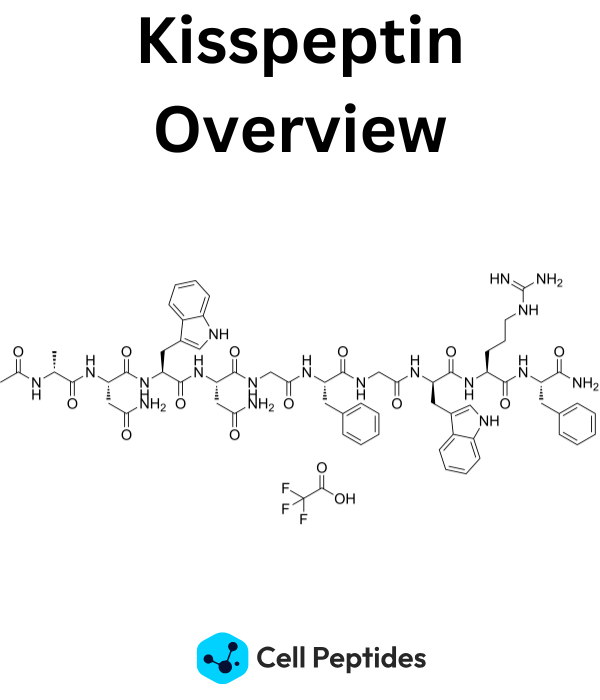
Kisspeptin-10 might be the smallest member of the kisspeptin family, but this little peptide punches well above its weight. Like all kisspeptins, it’s derived from the KISS1 gene — which got its chocolate-inspired name from the scientific team that discovered it, in Hershey, PA.
Small though it may be, Kisspeptin-10 has the full biological activity needed to bind to the GPR54 receptor responsible for firing GnRH pulses (and thereby basically keeping the entire reproductive system working).
When scientists first discovered Kisspeptin-10, they were mostly interested in its potential ability to fight cancer. Interest in the peptide for its ability to suppress metastasis was so strong that some of the early literature called it “metastin.” That spotlight shifted as research went on.
A sizeable portion of Kisspeptin-10 research today zooms in on its potential as a fertility treatment. Even more interesting to many is its “secondary role” — early Kisspeptin-10 studies have demonstrated that it can “fix” low libido and arousal challenges caused by mood and mental problems.
That quick overview? It might well be enough for people with no more than a passing interest in Kisspeptin-10. There’s much more to this particular story, however. Stick around if you want to find out what.
A Very Brief History of Kisspeptin-10
Every great discovery comes with a good story. This one starts in a place famous for its chocolate — Hershey, Pennsylvania. There, researchers identified a new gene with the apparent power to fight back against the spread of cancer cells. They called it KISS1, after the little chocolates. No surprise, then, that the peptides this gene produces became “kisspeptins.”
The early buzz was all about cancer. The longer form of the peptide, Kisspeptin-54, was dubbed metastin. A name that stuck. Slightly later research found that the peptide also played a critical part in reproduction. Nobody interested in peptides will be shocked — these chains of amino acids are often great multi-taskers.
The KISS1 protein naturally gets processed into much smaller fragments (as many as 145!), and all of these pieces bind to GPR54. That’s the receptor that activates GnRH, the reproductive hormone that makes LH and FSH — without which puberty, reproduction, and libido don’t “work” in men, women, or other mammals, for that matter.
Scientists discovered that switching KISS1 “off” causes hypogonadotropic hypogonadism — a total failure to go through puberty. Even more exciting? The reverse was also true. Activating it could trigger puberty. That discovery changed everything. Kisspeptin doesn’t only “have something to do with reproduction,” but it’s actually what controls the entire cascade. [1]
That includes libido — which more recent studies have focused on — but also mood regulation and metabolic health. Kisspeptin-10 has already made waves, but history is still being written.
How Does Kisspeptin-10 Peptide Work?
That actually depends on the biology of the body in which it’s active, but essentially, Kisspeptin-10 works like this:
- It makes its entrance. The natural form comes from specialized neurons in the hypothalamus — while its synthetic counterpart comes from a vial carefully synthesized in a lab to be identical to natural Kisspeptin-10.
- Kisspeptin-10 binds to KISS1R on GnRH neurons.
- Gonadotropin-Releasing Hormone gets pumped out.
- It then goes to the pituitary, where it triggers two more hormones — Luteinizing Hormone and Follicle-Stimulating Hormone.
- Those two then get around the body, where they can boost estrogen or testosterone (depending on the body!) and promote fertility.
Its anti-cancer action works a bit differently. Cancer cells have KISS1R receptors, too. When Kisspeptin binds to them, that inhibits (discourages, but doesn’t quite stop) cell migration, adhesion, and invasion. All of which are necessary for cancer to spread.
What Applications Has Kisspeptin-10 In Modern Science and Health Studies So Far (and What Could Be Next)?
Kisspeptin-10 is the foundational, essential HPG axis “trigger” — so it’s hardly surprising that clinical applications and future research directions aren’t limited to only one area. Curious what science has already uncovered about Kisspeptin-10? Good, because you’re about to find out, starting with the most established applications and finishing off with experimental and future directions. (It’s always best to save the most exciting for last, no?)
Diagnosing the Source of Hypogonadism
Why doesn’t a patient’s body produce enough sex hormones on its own — and more specifically, is the problem in the brain or the gonads? A dose of Kisspeptin can tell doctors exactly what’s working and what isn’t. That’s called a kisspeptin challenge test. If LH and FSH rise after a dose, the issue is likely to be with the hypothalamus. If not, it’s in the pituitary or with the gonads. [2, 3]
Kisspeptin-10 for a More Natural Approach to IVF
IVF relies on harvesting mature eggs — the stimulation and maturation of which, by pharmacological means, is well-known to be associated with Ovarian Hyperstimulation Syndrome. Research has looked at the possibility that Kisspeptin-10 can be used to mature oocytes instead, cutting that risk. [4]
Kisspeptin-10 as a Treatment for Low Libido and Sexual Dysfunction
Studies have already established that Kisspeptin-10 (as the smallest functional fragment) kickstarts and boosts the natural hormonal cascade. Research was always bound to zoom in on its potential effect on sexual function and libido — it was only a matter of time.
Animal studies have already looked at the impact Kisspeptin-10 has on the brain regions implicated in libido, with promising results. Only to be expected when you consider that Kisspeptin-10 works by restoring healthy, normal sex hormone levels in men and women. This application is still experimental, but among the most exciting future prospects. [5, 6] Current treatments for low libido and sexual dysfunction often push buttons that don’t need to be pressed. Kisspeptin-10 can, when used smartly, target the root causes in the brain.
Kisspeptin-10 as a Hormonal ‘Fountain of Youth’
Still speculative — but a huge area of scientific interest. Studies have already established that natural kisspeptin levels go down with age. That fact may indeed have something to do with the processes that get menopause and andropause going. It could also help explain why the risk of sexual dysfunction rises as the clock keeps ticking. [7, 8]
So, what if synthetic Kisspeptin-10 could step in to turn that hourglass upside down again? What if restoring LSH and FSH levels could create a hormonal balance naturally seen only in youth — but much later in life? That’s the next question scientists studying Kisspeptin-10 are starting to ask.
Mood, Metabolism, and Beyond
The link between mood and sex hormones is rock solid — see also PMDD and postpartum depression, for example. Research has established the potential for Kisspeptin-10 to play a part in treating some cases of infertility and low libido. Does what it does also extend to mood?
Animal studies have been trying to find out. Nothing definitive has been proven about humans, yet, but it is already clear that Kisspeptin-10 fights anxiety, has an antidepressant effect, and boosts energy in animal models. [9, 10]
That same process has a metabolic application, because the pancreas is home to kisspeptin receptors as well. This area is also still in its speculative phase, but Kisspeptin-10 administration improves glucose tolerance and circulating insulin levels in animal models. [11]
Metastasis Suppression — The Original Claim to Fame
To come back to the original research goal for Kisspeptin-10, cancer fighting is still an active area of research. In fact, it’s picking up steam. Science teams are now developing long-acting kisspeptin analogs that do the opposite of Kisspeptin-10 — suppress sex hormones, relevant for hormone-sensitive cancers like prostate cancer and some types of breast cancer. [12] Beyond that, stopping the cell migration that causes metastasis is also still researched, although this field hasn’t moved quite as fast as all the other ones.
How Is Kisspeptin-10 Administered in Research Settings?
If you’re familiar with peptide research, you know that getting peptides to their destination isn’t all that straightforward. Peptides are fragile and volatile. Digestive enzymes, which they’d be exposed to with oral administration, degrade them.
The literature so far has zoomed in on a few different delivery methods. The right one depends on the research goal.
Subcutaneous and intramuscular injection is by far the most common route in studies — because it comes with great bioavailability, because it leads to a release pattern more or less consistent with the natural thing, and because it’s practical for long-term animal research or multi-dose clinical trials in people. IV Kisspeptin has also been looked at. This makes the dose available immediately and has predictable peak concentrations, so it’s used for kisspeptin challenge tests. [13]
Besides these two common delivery methods, researchers have also developed intranasal Kisspeptin-10 for use in animal models — especially used for long-term studies. [14]
What are Calculated Kisspeptin-10 Dosing Protocols in Research?
With the “how” out of the way, “how much” is another obvious question. Study designs always base dosing protocols on their research goals and models. The same is true in all clinical settings.
For example, a kisspeptin challenge test is completed with a single dose. The subject will either react or not, and that single dose offers clarity. Fertility studies require multi-dose applications fine-tuned to achieve the goal at hand. Oncology studies rely on chronic high doses.
Research models vary considerably. (A mouse isn’t the same as a fish. Or a person.) Kisspeptin-10 doses can, to some extent, be calculated on the basis of body weight, but species-specific things still have to be taken into account. For human trials, doses of 1 to 4.8 mcg/kg or around 100 mcg daily have been cited. [15]
Literature cites the most common doses researched in humans were:
- 100mcg (micrograms) per day for 5 days;
- Increase to 250 mcg after a week and keep it for a month also taking weekends “off”.
Other variables are subject-specific. They include sex, age (AKA hormonal status), and health.
Contraindications — What’s Known About Who Isn’t a Candidate for Kisspeptin-10?
Contraindications (AKA “who shouldn’t take Kisspeptin-10”) are still being mapped out in research. Since Kisspeptin-10 boosts the release of GnRH and then triggers the release of LH and FSH to increase testosterone or estrogen, poor candidates are subjects likely to be negatively impacted by that surge.
They definitely include pregnant and lactating subjects. They usually include subjects with active hormone-sensitive cancer (unless studied in animal models for this purpose). Subjects with thyroid disorders or adrenal problems are also usually excluded. In future human trials, research subjects should not have PCOS or precocious puberty. Then, it’s also common practice to disqualify potential subjects with unrelated health issues — like heart disorders or liver disease.
Safety considerations are at the heart of any good study design. That’s true even in rodent models, because researchers want to account for all variables to get the juiciest and most reliable possible scientific results.
Peptides Studied Alongside Kisspeptin-10 in Multi-Peptide Research Designs
Experimental peptide research can lead investigators to zoom in on the interactions between peptides — sometimes referred to as stacking. The goal? To identify and study how multi-peptide protocols can lead to “the sum is greater than its parts” effects.
Some discussed protocols:
- Kisspeptin-10 + PT-141 — Kisspeptin-10 gets the whole HPG axis going, and PT-141 mainly impacts the central nervous system. The question of whether this combination can impact sexual function and desire more strongly than either alone is of interest to some researchers.
- Kisspeptin-10 + Ipamorelin — because both the HPG and GH axes are important to metabolic health and physique.
These combinations are exciting to researchers, but they’re also a challenge for a well-designed study. When two different peptides call for different timings and doses, and you suddenly have more variables to account for, science gets complicated. There’s an upside, too, though, and that’s the potential for entirely new findings.
The Exciting Questions Kisspeptin-10 Begs Researchers to Ask
Kisspeptin-10 has been on a wild ride since its discovery — and now you have, too. Its story started with cancer research, but Kisspeptin-10 is now known as the tiny peptide that triggers the whole reproductive cascade, from GnRH to testosterone and estrogen. That story is nowhere near done yet. Kisspeptin-10 studies have already tested it as a potential treatment for low libido and sexual dysfunction (with much more still to be discovered), but the next big research areas are related to mood, aging, and metabolism.
How might restoring kisspeptin levels impact age-related decline, in the sexual sphere and beyond? Given that its receptors are all over key brain areas, what role does Kisspeptin-10 play in treating mood disorders? Is it possible to use the tendency of kisspeptin to desensitize its receptor for future cancer treatment?
These are the questions researchers at the cutting edge can’t stand to leave unanswered — and they’re why Kisspeptin-10 is bound to keep making headlines in the future.
FAQs
The reproductive axis is the primary target — kisspeptin sets the release of GnRH, LH, and FSH in motion. None of the different endocrine systems are completely isolated from each other, though, and it’s quite possible that stimulating the reproductive cascade might indeed have indirect effects on other systems. How exactly? That’s what future studies will almost certainly find out.
The brain is home to plenty of kisspeptin receptors. Kisspeptin-10 doesn’t only talk to the pituitary, but to the systems that impact mood, emotion, and sexual desire too. Long story short? Kisspeptin-10 has the potential to affect the brain quite profoundly, and that’s exactly why studies looking at its role in depression and stress-related libido are taking off.
Yes, but quite indirectly. Trigger the GnRH cascade, and you get more FSH and testosterone — both needed for sperm production. Studies researching Kisspeptin-10 in the context of hypogonadotropic hypogonadism should catch the attention of anyone interested in low sperm counts caused by impaired brain signaling.
The numbers point to the amino acid counts here. Kisspeptin-54 has 54 — it’s the full-length chain, and it’s got a longer half life. Kisspeptin-10 has 10. It’s the shortest active fragment, and it does everything Kisspeptin-54 does. Just not for as long.
Scientific References and Sources
- https://www.thelancet.com/journals/landia/article/PIIS2213-8587(13)70098-6/fulltext[↩]
- https://portlandpress.com/clinsci/article/137/11/863/233116[↩]
- https://pmc.ncbi.nlm.nih.gov/articles/PMC7282711/[↩]
- https://link.springer.com/article/10.1186/s12958-024-01332-5[↩]
- https://www.cell.com/trends/endocrinology-metabolism/abstract/S1043-2760(25)00047-5[↩]
- https://www.thieme-connect.com/products/ejournals/abstract/10.1055/s-0039-3400992[↩]
- https://www.tandfonline.com/doi/abs/10.1080/09513590.2022.2028768[↩]
- https://link.springer.com/chapter/10.1007/978-3-319-63001-4_8[↩]
- https://www.nature.com/articles/s41574-020-00438-1[↩]
- https://pmc.ncbi.nlm.nih.gov/articles/PMC11589217/[↩]
- https://link.springer.com/article/10.1007/s00125-009-1283-1[↩]
- https://academic.oup.com/jcem/article-abstract/99/8/E1445/2537410[↩]
- https://karger.com/nen/article-abstract/102/3/238/220245/Potential-Clinical-Use-of-Kisspeptin[↩]
- https://journals.eco-vector.com/RCF/article/view/676528[↩]
- https://jamanetwork.com/journals/jamanetworkopen/fullarticle/2797718[↩]