
 Cart is empty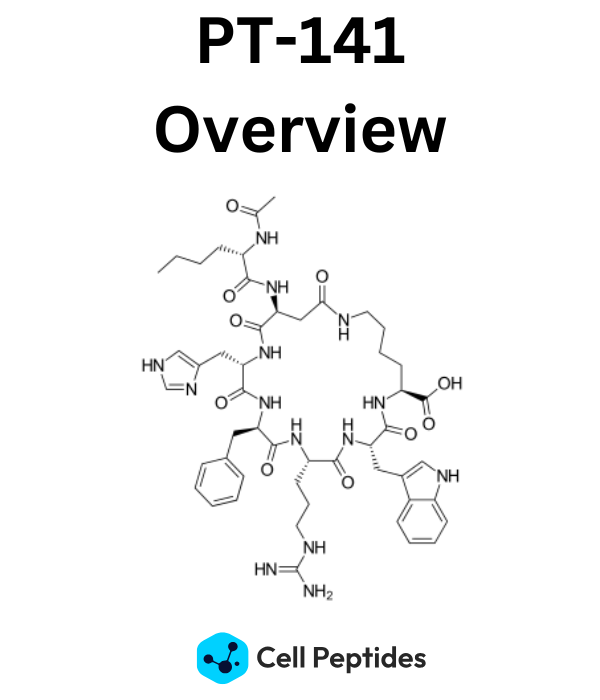
The below article and information is based on lab research data of PT-141, this is not medical advice in any kind of shape or form.
PT-141 — which also goes by the generic name Bremelanotide — is the side effect that became the main show. Early research into Melanotan 2, the famous sunless tanning peptide, picked up on a consistent and unexpected effect. That triggered the line of inquiry that ended in the creation of PT-141 (later approved as the drug Bremelanotide).
That effect? Spontaneous and intense sexual arousal.
PT-141 works radically differently from other established sexual function treatments. This melanocortin receptor agonist targets the central nervous system, where it activates the MC4R receptors in the hypothalamus. That’s the region that regulates primal things — hunger and mood, but also libido.
Not all sexual dysfunction results from hormonal or physical problems. Many actually start in the brain. PT-141 is an exciting research compound for those cases, which have long been neglected in science. Research applications start with sexual dysfunction caused by psychological and neurological issues, as well as those related to SSRI use.
Some would say the science was settled when Bremelanotide got its FDA approval for hypoactive sexual desire disorder in premenopausal women, but many see much deeper future potential. PT-141 is a key peptide for anyone who wants to understand how sexual desire comes about.
A Brief History of PT-141 & How It Was Discovered
PT-141 is a “Melanotan 2 spin-off.” The research team that discovered it didn’t set out to develop a peptide to target low libido and desire — they were working on a sun-free tanning compound that could shield people from skin cancer. The male subjects of their early human trials came to them with rather surprising findings, however. Hours after administration, they had spontaneous erections. [1]
They quickly caught onto the fact that they’d created a peptide with great potential in an area that had left many people without workable treatment options. That’s when they switched gears and isolated the precise compound that targets arousal pathways — without the other effects of Melanotan 2. That’s PT-141.
How Does PT-141 Work?
It’s a melanocortin receptor agonist that finds and binds to MC4R and other melanocortin receptors in the brain. Once there, it’s basically an on switch for sexual desire.
There’s actually still a lot to be learned about how this works, but the basic idea is this. Once PT-141 gets to those melanocortin receptors, it gets a whole cascade of sexual motivation going, via feel-good neurotransmitters like dopamine.
Other sexual dysfunction and libido treatments (you know the ones) tend to zoom in on root causes that don’t always apply. They help people who don’t have problems with arousal but with vasculature, or they target hormonal deficiencies. Those treatments are important — but they do nothing for people with arousal and desire problems that start in the brain. PT-141 changes everything for them. It reawakens desires that still exist but just so happened to be buried somewhere deep in the brain. Where they couldn’t be reached.
How Can PT-141 be Applied & What Are Its Effects in Research?
Some peptides have broad, systemic effects — they do different things for different body systems. PT-141 isn’t one of those peptides. It was never designed as such. It’s a targeted peptide with a singular purpose. The contexts across which it has been researched are, on the other hand, amazingly diverse. As the body of science has grown, so has the potential of Bremelanotide. PT-141 has already been FDA-approved to treat Hypoactive Sexual Desire Disorder in women, but future applications are on the horizon.
PT-141 Research Into Treating Disorders of Sexual Desire
HSDD isn’t exactly a household name, but this disorder of sexual desire is more common than most people know. Researchers estimate that it affects one in 10 women, and they think it’s caused by a combination of three things. Unbalanced neurotransmitters (dysregulated levels of norepinephrine, dopamine, and serotonin), hormonal problems, and “increased inhibition.” That is, some sort of barrier that prevents sexual enjoyment and desire from working, even if the underlying will is there. [2]
Studies show that PT-141 is effective in this context. It creates the desire that was previously lacking, alleviates the very real sense of distress caused by low libido (including its impact on relationships), and it makes people robbed of desire feel satisfied in the bedroom again. [3]
PT-141 is only so far approved to treat HSDD in women, but research demonstrates that it’s just as effective for men. [4] It’s unique — no other treatment does what Bremelanotide does. Studies that further the goal of making it accessible to men in clinical settings are next on the agenda.
Findings with Regard to PT-141 and Erectile Dysfunction
This was the original domain, the finding that led to the development of PT-141 in the first place — so it’s no surprise that PT-141 can, indeed, make erections that weren’t quite forthcoming before appear. Current study directions touch on one important thing. Erectile dysfunction often has multiple causes. When neurology is one of them, PT-141 can come to the rescue. That’s been shown in its success in men who weren’t helped by PDE5 inhibitors. [5]
For some, however, mind and body work together to create a nasty storm that ends with all-round sexual dysfunction. In these cases, PT-141 might be used in conjunction with PDE5 inhibitors to solve two issues at the same time. Human trials have found that men treated with Bremelanotide feel more satisfied and less anxious, that sexual function returned, and that problems with climaxing improved. [6]
PT-141 as a Solution for SSRI-Induced Sexual Dysfunction
Low libido and sexual dysfunction are common side effects of antidepressants, and especially SSRIs. This problem affects a huge percentage of people prescribed these drugs — some studies say that number is as high as 70 percent. That’s because SSRIs work on serotonin, which can kill desire. PT-141 fixes this problem without interacting with antidepressants, because it works on melanocortin receptors.
Would you trade depression for sexual dysfunction? Millions with major depressive disorder and related conditions haven’t had much of a choice, and that actually leads many to stop taking SSRIs. With Bremelanotide on the horizon as a potential treatment for SSRI-induced low libido, the possibility that people won’t have to face this dilemma is a very exciting one. [7]
It gets even better, though, because the melanocortin system does more than spark desire. Although this kind of research is still in its very early stages, it’s not implausible that PT-141 could one day become a new kind of treatment for depression itself. [8]
And Beyond?
The fact that PT-141 jumpstarts desire and physical function hasn’t gone unnoticed. The peptide has also caught the attention in research corners interested in turning existing arousal and sensitivity patterns up a few notches. The kind of stale drive associated with getting older is one direction, and it has the clear potential to improve relationships and make aging a little more pleasurable.
How Is PT-141 Administered in Research Settings?
The main route of administration is also the most effective one. In clinical and research settings alike, that’s subcutaneous injection (or alternatively – intramuscular). Patients prescribed PT-141 for HSDD have the convenience of being able to do this themselves — it’s not too hard to master injecting it into the fatty tissue just under the skin, usually in the thigh or abdomen.
This method also allows for controlled and predictable absorption, and effects usually set in within a few hours.
Self-injection is intimidating to some people with a prescription, on the other hand, and that does create a bit of a barrier. Those who don’t want to miss out on the benefits of PT-141, even if they would very much benefit. Research is looking at alternative options. A nasal spray may become available in the future. Oral formulations or even topical creams are also interesting possibilities. For now, though, subQ is the standard.
What Are the Most Common Dosing Protocols in PT-141 Studies?
PT-141 has come a long way since it was developed. Its FDA approval for HSDD in women informs all researchers designing future human trials, and many studies look at variations of the approved dosing protocol. Clinical dosing — for the approved drug — is an important point of reference.
The approved regimen is a 1.75 mg dose, across the board and not based on weight. Women prescribed PT-141 for HSDD self-administer this dose with a prefilled autoinjector as needed, which means 45 minutes to an hour before planned activity. In that setting, patients are limited to one dose per 24 hours preferably taking a few days per week off. That’s because excessive doses can limit efficacy. [9]
In other biohacking circles, researchers successfully use lower doses ranging from ~0.25mg to 0.5-0.75mg per day depending on the case severity.
Research isn’t, of course, limited to this established dosing protocol. New study designs — for example, ones that investigate antidepressant potential — would use different regimens.
What Has Research Shown About PT-141 Contraindications?
A lot. Because Bremelanotide has an FDA-approved application and an extensive history of clinical trials, there’s ample data about its most common side effects and established contraindications. Understanding both is critical during the study design phase of new research.
The side effects reported most often are usually temporary and manageable. Nausea is the most common one; a minority of participants in all human trials report it, although it passes. Facial redness and headache are next on the list. For a small number of participants, nausea turns into vomiting.
As far as who shouldn’t be given PT-141 goes, early research into nasal spray as a delivery route identified temporary high blood pressure as a possible side effect. People with uncontrolled hypertension shouldn’t take PT-141 for that reason, and that reason extends to anyone with cardiovascular disease. [9] Besides that, Bremelanotide has an unknown safety profile for pregnant and nursing women — who, to be fair, aren’t the approved patient group either as PT-141 is approved for HSDD in premenopausal women.
PT-141: The Sexual Desire Peptide That Targets the Central Nervous System
Some of the most exciting scientific discoveries have always come about quite accidentally, and PT-141 is nothing if not a case study in exactly that. Research that started off with the goal of creating a protective suntan (without the UV rays) ended up shedding light on some of the most important aspects of libido and desire.
PT-141 is already in clinical use — but its potential doesn’t end with HSDD. Future editions of medical journals are sure to demonstrate how this peptide impacts sexual dysfunction caused by SSRIs and whether it has real promise as an antidepressant. It might even answer deeper questions about sexual desire, some already asked and some not.
FAQs
No. PT-141 is a fragment of Melanotan 2 that maximizes libido boosting and boots everything else that peptide does. PT-141 doesn’t create a tan.
Alcohol and PT-141 have no known interactions at all, but doctors do advise women prescribed Bremelanotide for HSDD to avoid drinking in the hours after self-injecting it. The logic is clear. Drinking can cause nausea, and avoiding drinking helps some people who’d otherwise feel queasy escape that.
Yes, that’s part of how it works. PT-141 triggers dopamine release when it hits the melanocortin receptors, in the parts of the brain that regulate motivation and reward.
A common question for some reason, but no. Clinical trials haven’t identified tiredness as being among the potential side effects of PT-141.
Preclinical studies have investigated this, and are continuing to do so. The possibility that PT-141 might have antidepressant and anti-anxiety effects is an area of increasing interest — but much more research needs to be done before this question can be answered with a resounding “yes.”
Scientific References and Sources
- https://www.sciencedirect.com/science/article/abs/pii/S0196978105004602[↩]
- https://www.cambridge.org/core/journals/cns-spectrums/article/abs/neurobiology-of-bremelanotide-for-the-treatment-of-hypoactive-sexual-desire-disorder-in-premenopausal-women/CB2718A94BC8F52E562867A0F1689B15[↩]
- https://journals.sagepub.com/doi/abs/10.1177/1060028019899152[↩]
- https://academic.oup.com/jsm/article/21/Supplement_6/qdae161.029/7916923[↩]
- https://www.sciencedirect.com/science/article/abs/pii/S0022534707028388[↩]
- https://academic.oup.com/jsm/article/21/Supplement_1/qdae001.225/7600627[↩]
- https://journals.lww.com/clinicalobgyn/abstract/2025/03000/novel_pharmacologic_treatments_of_female_sexual.4.aspx[↩]
- https://www.mdpi.com/1422-0067/24/7/6664[↩]
- https://reference.medscape.com/drug/vyleesi-bremelanotide-1000296[↩]