
 Cart is empty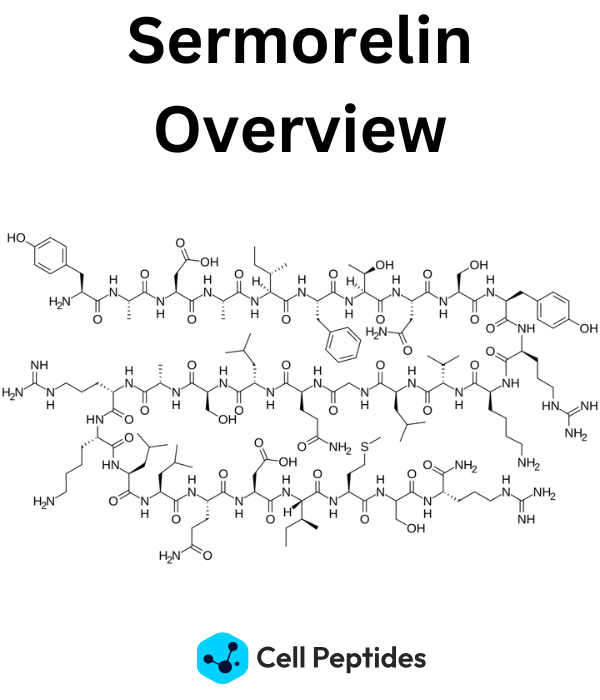
*The below article and information are based on lab research data of Sermorelin, this is not medical advice in any kind of shape or form.
Sermorelin is the “original” GHRH analog — the first synthetic version to be developed. Some are quick to dismiss it as a weaker alternative to CJC-1295 with a shorter half-life, but Sermorelin is interesting to researchers because it’s so targeted. Sermorelin is the shortest fully active fragment of natural Growth Hormone-Releasing Hormone.
That fact has an advantage. Sermorelin gives investigators who want to study the effects of a stronger but natural and pulsatile GH signal the purest, most physiological, most direct peptide. While steering clear of the continuous GH stimulation that longer-acting GHRH peptides bring.
Studies have zoomed in on everything from muscle mass boosting to better metabolic rates, and from deeper slow wave sleep to tissue repair. Also exciting? Some early research demonstrates a positive impact on mental sharpness and even more general anti-aging effects.
A Brief History of Sermorelin Peptide
Scientists knew that the pituitary released growth hormone long before they figured out what made it do that — although they did speculate that the hypothalamus, which sits right above the pituitary, had something to do with it.
Roger Guillemin and Andrew Schally picked through sheep and pig brains (to the tune of several million!) to find that signal. They earned a Nobel Prize when they identified several hypothalamic peptides, but Growth Hormone-Releasing Hormone wasn’t isolated until 1982. That discovery? All thanks to a patient with a rare pancreatic tumor that so happened to make excessive amounts.
GHRH itself is 44 amino acids long, but not all of them are necessary for it to work. Sermorelin was developed after the discovery that only the first 29 amino acids are biologically active. It’s less difficult to synthesize than the full chain, but other than that, Sermorelin is identical to its natural equivalent. [1, 2]
How Does Sermorelin Work?
Exactly the same way as natural Growth-Hormone Releasing Hormone — which is why Sermorelin has such diverse research applications.
- Sermorelin makes its way to the GHRH receptors on the pituitary.
- Once there, it signals the gland to release its existing growth hormone stores in natural pulses.
- This process also triggers an IGF-1 boost. Insulin-Like Growth Factor lets the pituitary know it’s time to halt GH release, but alongside that, it boosts muscle and bone growth, too.
Sermorelin is simple, elegant, and short-acting, just like the natural version. It’s a step up from synthetic growth hormone for patients with deficiencies who need a boost. More than that, it’s the research compound of choice for any study design looking at acute effects.
As for what a short, sharp, and natural growth hormone boost does? It takes a look at the impressive body of science Sermorelin research has so far produced to find out.
What Was Sermorelin Researched For So Far (What Were Its Effects and What Could Be Next)?
Sermorelin is the purest, shortest synthetic GHRH analog. It boosts growth hormone in the most natural possible way — and that gives researchers a great chance to study the benefits of optimizing GH and IGF-1 levels. It’s no surprise, then, that studies have looked at a huge variety of applications. Some (like muscle growth) are obvious when you know what growth hormone does. Others? Not so much.
Curious what interesting findings Sermorelin research has yielded so far? You’ll hear about the most promising applications right here.
Sermorelin for Muscle Growth and Maintenance
The main effect of Sermorelin is clear. It spikes natural GH pulses and boosts IGF-1 — and thereby makes it easier to build and maintain lean muscle mass. That’s the effect that gives Sermorelin its reputation among bodybuilders and athletes who don’t want to take synthetic growth hormone, but make no mistake. That same effect has the massive potential to treat muscle loss caused by disease (hypogonadism) or age (AKA sarcopenia). [3, 4]
Studies have already demonstrated that Sermorelin works to preserve muscle mass and strength. Still to come? Clinical trials that might open the door to clinical use. Strength and function in later life aren’t merely “nice.” This potential sarcopenia treatment could one day help people stay independent for longer.
A Natural GH Boost for Deeper Sleep — and Everything That Follows
Strong natural growth hormone pulses lead to optional slow-wave sleep, and studies into the idea that Sermorelin might help people achieve deeper, more restorative sleep cycles have already had positive results. It’s understandable if that immediately makes you think of the potential to treat sleep disorders, but the real excitement goes even deeper. Disturbed slow-wave sleep has all sorts of knock-on effects. It’s the type of sleep that makes building memories, consolidating new information (= learning), and recovering from stress easier.
Research so far has looked at how restoring more youthful growth hormone pulses might impact cognitive decline, but also at how better slow-wave sleep affects healthy adults. Deeper, more restorative sleep is, as it turns out, critically important to overall health — cognitive health, but also wound healing and muscle recovery. [5, 6, 7]
Potential Effects on Libido and Sexual Function
The connection between Sermorelin and sexual function (including libido) is still an area of investigation. Sermorelin doesn’t specifically target this area, in contrast to some other peptides, but it is clear that optimizing GH and IGF-1 has positive effects on mood, energy, and physique. All these things set the stage for a satisfying sex life. Plus, the GH/IGF-1 system has some interplay with the HPG system that governs sex hormones — so reports that note a link are out there. [8]
That’s mostly exciting to researchers studying the effects of Sermorelin in other contexts, because libido might show up as a downstream benefit.
The Potential Metabolic Effects of Sermorelin
A serious growth hormone boost that doesn’t disrupt natural pulses has several potential implications for metabolic processes. The muscle mass increase Sermorelin creates directly improves basal metabolic rate, and a GH boost has already been established to trigger lipolysis — fat burning. [9]
Future study designs are more likely to investigate the benefits of metabolic optimization in muscle preservation contexts than to consider Sermorelin for obesity management, but studying Sermorelin as a way to improve insulin resistance is another viable possibility.
Sermorelin in Cognitive Health and Brain Aging Research
We’ve already seen that Sermorelin has been researched in areas as different as muscle mass and deep sleep — but there’s another application, too. IGF-1 increases neuroplasticity (“brain flexibility”) and neuron health. Could Sermorelin slow so-called “brain-aging” and improve memory and learning, with regard to age-related cognitive decline and beyond?
That’s an emerging area that definitely calls for further study, but research that demonstrates declining IGF-1 and growth hormone levels as being associated with cognitive decline exists. [10]
How Is Sermorelin Administered in Research Settings?
Sermorelin is “just” the biologically active fragment of natural Growth Hormone-Releasing Hormone — 29 amino acids. It’s of interest to researchers who value the characteristics that come with this natural state, but Sermorelin hasn’t been lab-modified in any other way than to shorten GHRH.
That means it’s got a short half-life, which dictates the delivery method. Subcutaneous or Intramuscular administration is the standard route of administration, and essentially the only viable option. It results in predictable absorption rates into the bloodstream and prevents spikes that diverge from physiological processes.
After lyophilized Sermorelin is reconstituted to make it suitable for multi-dose research, researchers administer it in the fatty tissue under the skin. In the case of human trials, that means a thigh, upper arm, or the abdomen.
Sermorelin comes in, stimulates GH pulses, and exits. That’s where it differs from peptides with extended-release effects. The most natural possible effect is the result, but that does mean more frequent dosing. Most studies use daily injections, usually right before sleep — you want a big GH pulse right then. Timing therefore has to be calculated with the model’s sleep patterns in mind. Mice, for example, are mostly nocturnal, and that would impact the timing of the dose.
How Do Researchers Determine Dosing Protocols for Sermorelin
Researchers look for a balance — they’re after a solid growth hormone response, but they don’t want to overload the pituitary and cause desensitization. Hence, Sermorelin dosing protocols actually aren’t usually based on the subject’s body weight.
They’re more likely to use a standardized dose — 0.25 to 1 mg a day for clinical trials.
When studying it yourself – always start from the lowest dose and gradually move it up while observing it’s effects.
The existing body of science, especially in growth hormone deficiency contexts, has made this standardization possible. This dose is, of course, adapted depending on the research goal. Muscle maintenance and building research logically tends toward the higher end of this dose, but sleep studies might use protocols below this standard. Study designs also account for subject-specific things — like baseline IGF-1 levels.
Sermorelin gets natural pulses going, but excessive stimulation can actually desensitize the GHRH receptors. Research designs can minimize the risk of that unwanted effect through protocols that include pauses. Just like most people do, Sermorelin can “go to work” five days a week and then take a two-day break, for instance. Protocols of this kind preserve one of the main benefits of Sermorelin — that it replicates natural processes.
Are There Any Contraindications?
Yes. Nobody for whom a growth hormone dose would be dangerous should be included in Sermorelin studies. That’s why study designs for human trials deliberately exclude potential participants with active cancer or a history of it, with serious chronic or acute conditions (for example, just recovering from surgery), and of course pregnant and breastfeeding women.
One interesting fact? Growth hormone itself is generally avoided in type 2 diabetics, but Sermorelin actually isn’t contraindicated for them. Indeed, Sermorelin has the potential to improve insulin sensitivity.
Sermorelin vs Other GHRH Analogs: How Do Researchers Choose?
Sermorelin might have been the first synthetic GHRH analog, but two more have since joined the spectrum of options — CJC-1295 without DAC and CJC-1295 with DAC.
Sermorelin is the pure, unmodified GHRH fragment that gets closest to the natural thing. Its action doesn’t differ from endogenous Growth Hormone-Releasing Hormone, but neither does its half life. The need for daily dosing is its main disadvantage.
CJC-1295 without DAC is pretty similar, but has a half life of about 30 minutes. The risk of receptor desensitization is low with CJC-1295 (no DAC), too. CJC-1295 with DAC has a much longer half life, which means it acts on GHRH receptors for extended periods. Some researchers see that as the opposite approach. What’s gained with the advantage of weekly dosing could be lost by creating a less natural profile — depending on study objectives.
Out of the three GHRH analogs, Sermorelin — the first kid on the block — is still the gentlest and most natural.
Sermorelin — The OG GHRH Analog Researchers Pick for Precision
Newer and more long-acting Growth Hormone-Releasing Hormone analogs have been around for a while now. Sermorelin has never lost its value, though. Sermorelin boosts GH as nature intended, and for that reason, it’s sure to stay interesting to researchers who want to study metabolism, cognitive function, muscle, and sleep.
FAQs
Dermatology is actually a well-documented area of inquiry. An IGF-1 boost gets elastin and collagen production rolling, and those proteins are important for skin elasticity and thickness. The potential to fight skin-aging exists.
Sermorelin seems to induce longer slow-wave sleep cycles as it strengthens natural growth hormone pulses — and spending more time in this deep sleep in turn boosts GH levels more. It’s a feedback loop in which both components strengthen each other.
Some research designs are built with acute objectives in mind — like observing the effects of a quick IGF-1 boost. They might not last longer than a few weeks. It takes consistent administration over the course of three to six months to notice the strongest effects, on the other hand.
Studies don’t usually look at the possible impact Sermorelin might have on mood as a main goal, but they do tend to note improved mood as an outcome. Sermorelin isn’t likely to be a direct mood booster — rather, better sleep, more energy, and positive body composition outcomes create better wellbeing.
Scientific References and Sources
- https://pmc.ncbi.nlm.nih.gov/articles/PMC4151340/[↩]
- https://www.sciencedirect.com/topics/pharmacology-toxicology-and-pharmaceutical-science/sermorelin[↩]
- https://pmc.ncbi.nlm.nih.gov/articles/PMC7108996/[↩]
- https://onlinelibrary.wiley.com/doi/full/10.1002/rco2.9[↩]
- https://pmc.ncbi.nlm.nih.gov/articles/PMC6430170/[↩]
- https://jamanetwork.com/journals/jamaneurology/article-abstract/1676654[↩]
- https://link.springer.com/chapter/10.1007/978-3-031-84693-9_2[↩]
- https://www.taylorfrancis.com/chapters/edit/10.1201/9781003297826-9/gh%E2%80%93igf-1-axis-hypothalamic%E2%80%93pituitary%E2%80%93testicular-axis-drug-development-gabriel-gbenga-babaniyi-ulelu-jessica-akor-ebunoluwa-elizabeth-babaniyi[↩]
- https://archive.hshsl.umaryland.edu/entities/publication/826b2485-8124-4f22-88a1-7b6fad66f47e[↩]
- https://www.liebertpub.com/doi/abs/10.1089/10945450152850641[↩]